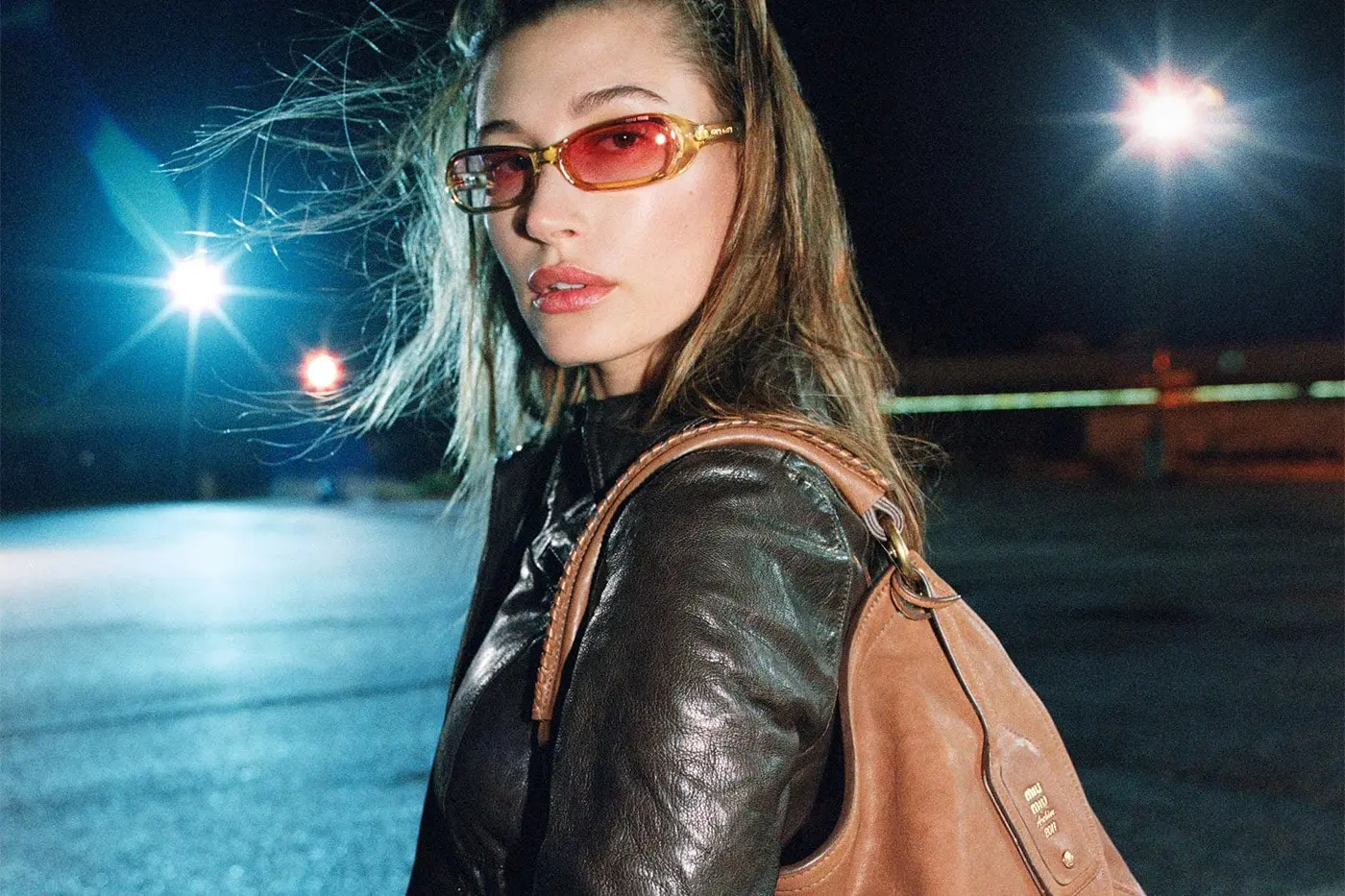
The shearling coat hangs loose at the shoulder, its bulk overwhelming the frame in a way that reads as deliberate rather than incidental. Hailey Bieber stands against what appears to be industrial concrete washed in amber light, the kind of setting that suggests a loading dock at 2 a.m. rather than a studio build. This is Miu Miu's Fall/Winter 2026 campaign.
Photographer Zoe Ghertner and director Renell Medrano position Bieber and Xiao Wen Ju within environments stripped of the Mediterranean sunshine that dominated Prada and Miu Miu campaigns for the past three seasons. The shift registers immediately. Miu Miu's recent visual language has favored tennis clubs, poolsides, bleached surfaces. This campaign chooses warehouses, night hours, and abstract color fields that suggest film noir more than resort catalog.
The collection itself mixes washed fabrications with oversized outerwear. Silhouettes run loose where they were fitted in Spring, layered where they were minimal. Ghertner's photography emphasizes texture over construction, letting the material occupy more visual space than the tailoring details that would typically anchor luxury campaign imagery.
Bieber's casting continues a multi-season relationship with the house. She appeared in Miu Miu's Spring 2024 campaign and walked in the Fall 2023 show. The consistency suggests a longer brand partnership than the standard seasonal rotation, though neither party has disclosed contract terms. Xiao Wen Ju, a veteran of Prada and Miu Miu campaigns dating to 2011, provides continuity with the house's established casting history.
The campaign's press release emphasizes "fluid femininity" and "contrasts of vulnerability and control." The language operates at the level of mood description rather than product attribute. It does not mention the prices of the shearling coats visible in the frames. It does not name the specific garments being photographed. The communication strategy treats the collection as atmosphere rather than inventory.
The pairing of Ghertner and Medrano splits the campaign's visual logic across still and moving image in a way that few luxury houses attempt. Ghertner's work foregrounds texture and material weight; Medrano's directorial history favors kinetic intimacy and close observation of gesture. The combination suggests Miu Miu wants its audience to experience the collection twice, through different sensory registers, rather than receiving a single unified message.
Bieber's multi-season presence and Xiao Wen Ju's decade-plus history with the Prada Group create an unusual temporal layering within the cast. One model represents the house's current cultural moment; the other anchors it to a longer institutional memory. The campaign asks both women to inhabit the same nocturnal atmosphere, collapsing the distinction between legacy and novelty that luxury branding typically enforces.
Miu Miu's recent commercial performance has outpaced Prada's mainline in percentage growth terms, a reversal of the traditional relationship between the brands. The nocturnal campaign arrives during a period when the sub-label carries unusual commercial weight within the Prada Group portfolio. The darker visual register reads as a house betting on its own momentum rather than hedging against market uncertainty. The clothes now occupy a different room than they did six months ago, and the light has changed because Miu Miu changed it.