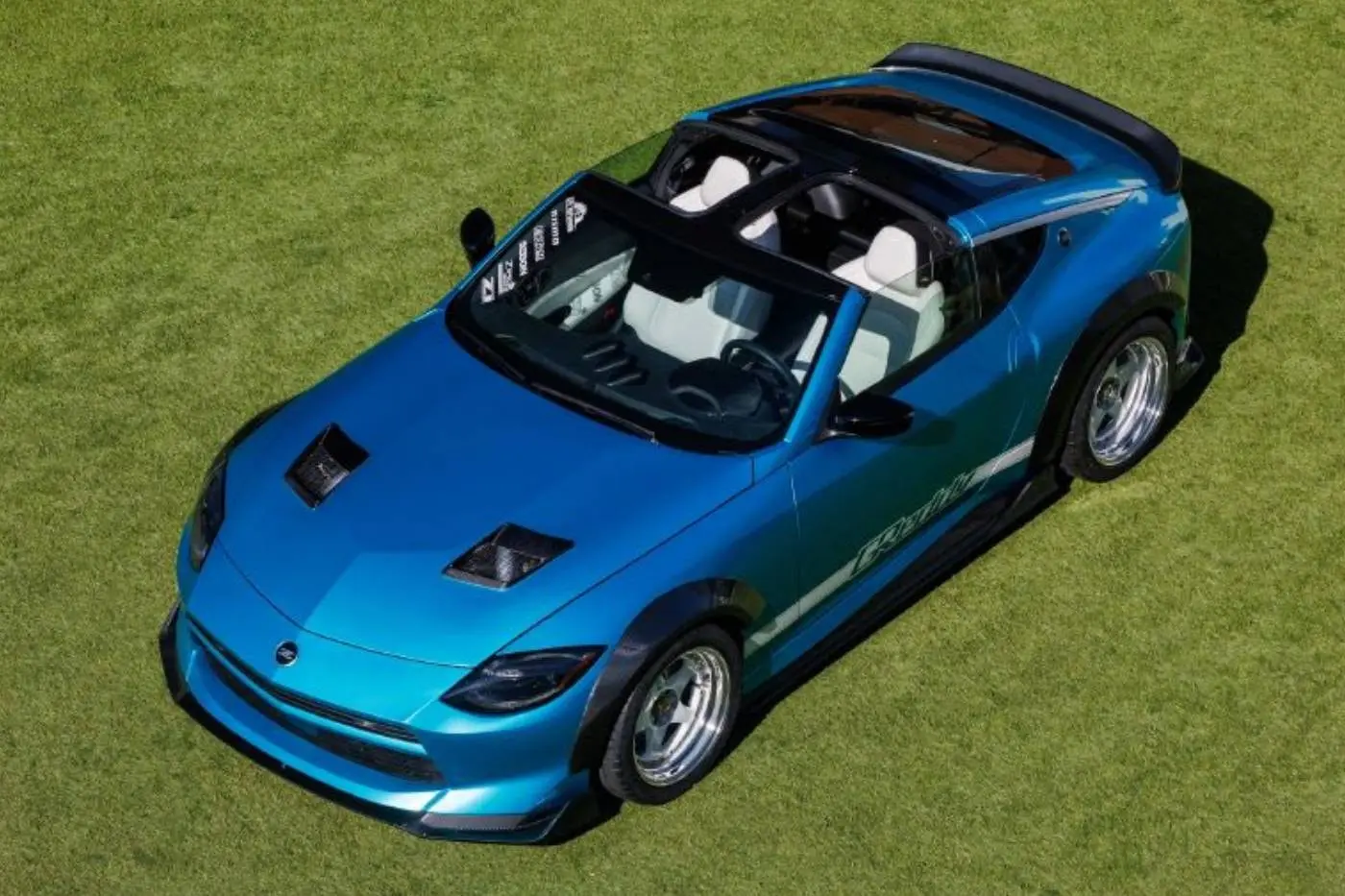
The mechanism here is straightforward: a car company builds a concept only after its own enthusiast community has spent two decades converting a discontinued feature into a wish list item, and the concept is less a design breakthrough than a delayed acknowledgment of demand that already existed. The Z Kaze Concept revives the T-top roof last seen on the 300ZX era, a body style Nissan phased out well before the current Z generation, and it debuted not at a motor show but at ZCon, an owner and enthusiast gathering in Phoenix built by and for the people who kept that demand alive without a factory product to point to.
You have seen this shoe before, in a different category: a brand lets a retired feature calcify into folklore among a shrinking fan base, then reintroduces it as a limited concept once the nostalgia has fully priced in. The Z Kaze pairs the T-top with authentic 18 inch Nismo LMGT2 wheels and GReddy mechanical upgrades on top of the standard twin turbo V6, built internally as what Nissan calls a passion project rather than a production roadmap. That framing matters. A passion project can be shelved without earnings consequence. A production commitment cannot.
The venue choice sharpens the read. ZCon is not the Detroit Auto Show or a shareholder event, it is a gathering built by owners who kept 300ZX and 350Z T-top culture running through forums, meets and restoration shops long after Nissan stopped supplying the parts. Unveiling the concept there instead of at a mainstream auto show signals that Nissan is speaking directly to the community that sustained the demand, not to a general market that never asked the question. That is a narrower audience than a typical concept reveal targets, and narrower audiences convert to preference faster when a brand actually ships, because the appetite has been pre-tested for twenty years.
Nissan built the Z Kaze Concept as a passion project, not a production commitment, and that distinction is the whole story. A passion project can tour ZCon, collect applause from the owners who kept T-top demand alive for two decades, and then disappear without costing the company anything. A production commitment cannot. The test is simple: if the T-top format shows up on a production Z variant within the next two model years, Nissan closed the gap between its own fans and its own factory. If it does not, the Z Kaze joins the long list of nostalgia concepts built to generate goodwill at a fan convention and nothing more. Watch the 2027 model year lineup for the verdict.