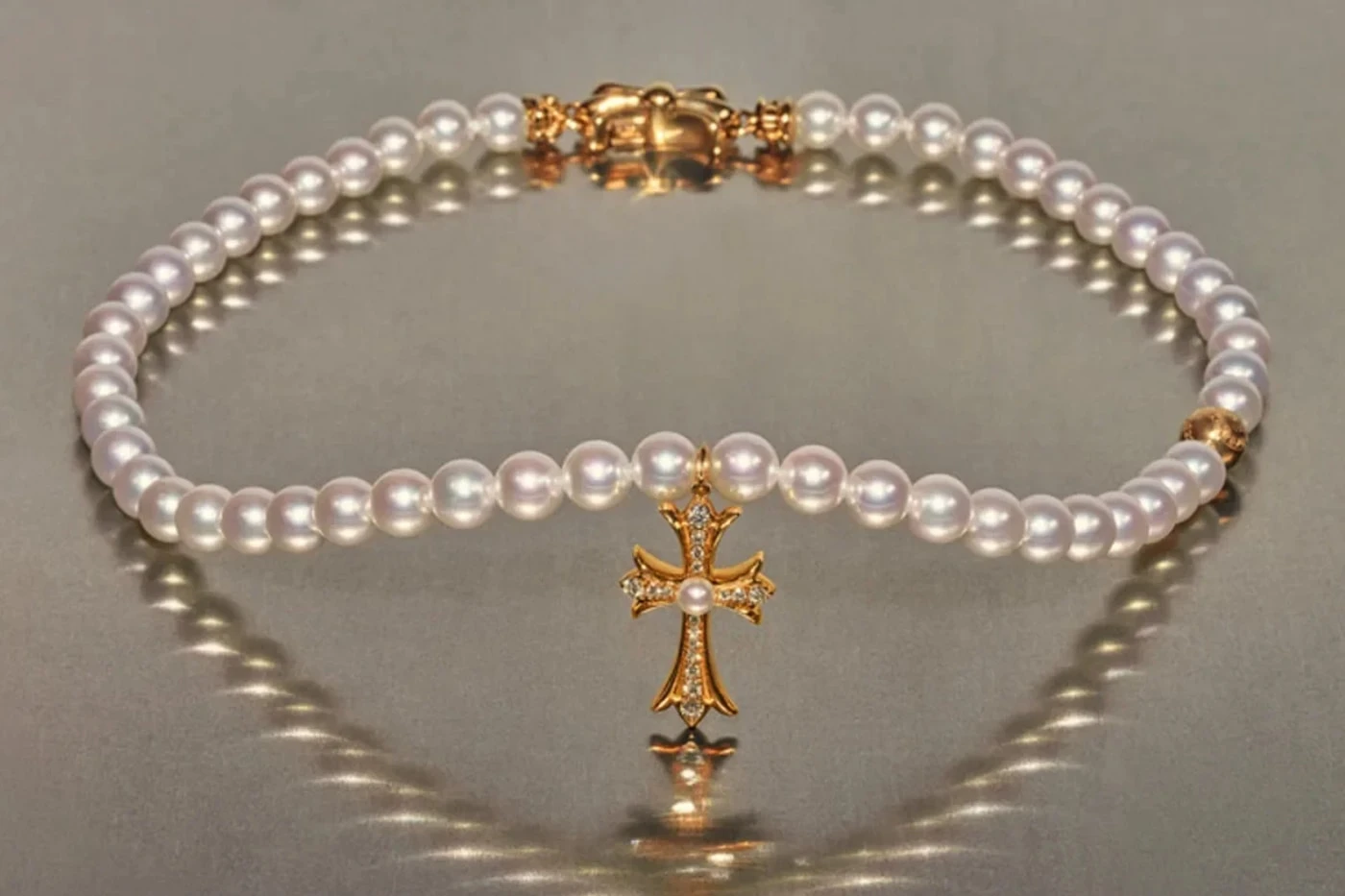
The cross sits in the palm, heavier than expected. 22k yellow gold has that quality, the softness that resists daily wear but confirms value on contact. Mikimoto and Chrome Hearts are now releasing the second installment of their collaborative jewelry line, and the material shift from the first drop's white gold to this collection's yellow gold is the clearest signal of where the partnership intends to land.
The collection comprises a necklace, bracelet, brooch, and two drop earrings. Akoya pearls remain constant across both releases. The cross motif, Chrome Hearts' signature since the label's founding in 1988, persists. What changes is the metal specification: 22k gold, not 18k, not 14k. The higher karat indicates a purity level more common in South Asian and Middle Eastern fine jewelry markets than in American luxury goods. It is a material choice that reads differently in Tokyo than in Los Angeles.
Mikimoto's history with gold is long. The house has produced high-karat pieces since Kokichi Mikimoto pioneered cultured pearl farming in the 1890s, and its archives hold ceremonial objects commissioned by the Japanese imperial family. Chrome Hearts' history with gold is shorter but no less deliberate: the label's furniture, eyewear, and leather goods have consistently used gold hardware as a marker of the brand's position between streetwear and couture.
The first drop sold through both brands' boutiques within weeks of release. Resale pricing on the white gold pieces now exceeds retail by margins typically associated with limited sneaker releases. The second drop, available now at select Mikimoto and Chrome Hearts locations, enters a market that has already priced the collaboration as collectible.
The karat specification deserves closer reading. By selecting twenty-two karat gold rather than the eighteen or fourteen karat alloys standard in American luxury jewelry, Mikimoto and Chrome Hearts have oriented the collection toward markets where gold purity carries different cultural weight. South Asian and Middle Eastern buyers have long favored higher karat gold for its intrinsic value and its legibility as wealth; American and European houses have historically preferred lower karat alloys for their durability and workability. The choice positions these pieces as objects that speak fluently across those traditions, legible as serious metal in Mumbai or Dubai while retaining the design vocabulary that Chrome Hearts established in Los Angeles.
The Akoya pearls compound this layering of reference. Mikimoto's cultivation method, developed more than a century ago, remains the foundation of the modern cultured pearl industry; the pearls carry institutional weight that Chrome Hearts' cross motif, itself now decades old, cannot claim on its own. Together, the elements produce an object whose provenance is simultaneously Japanese and Californian, traditional and subcultural, materially precious and semiotically charged. That the first collection cleared retail inventory within weeks and now commands premiums on secondary markets confirms that buyers have registered this convergence and are pricing it accordingly.
What the collaboration represents is a category that does not yet have a settled name. It is not costume jewelry. It is not traditional high jewelry in the Cartier or Van Cleef sense. It is not streetwear accessories, though Chrome Hearts' clientele overlaps substantially with that market. The pieces occupy a space where material value, brand signification, and subcultural affiliation converge, and where the buyer is as likely to display the item in a case as to wear it. This is jewelry as cultural artifact, priced accordingly, now rendered in a metal that appreciates.