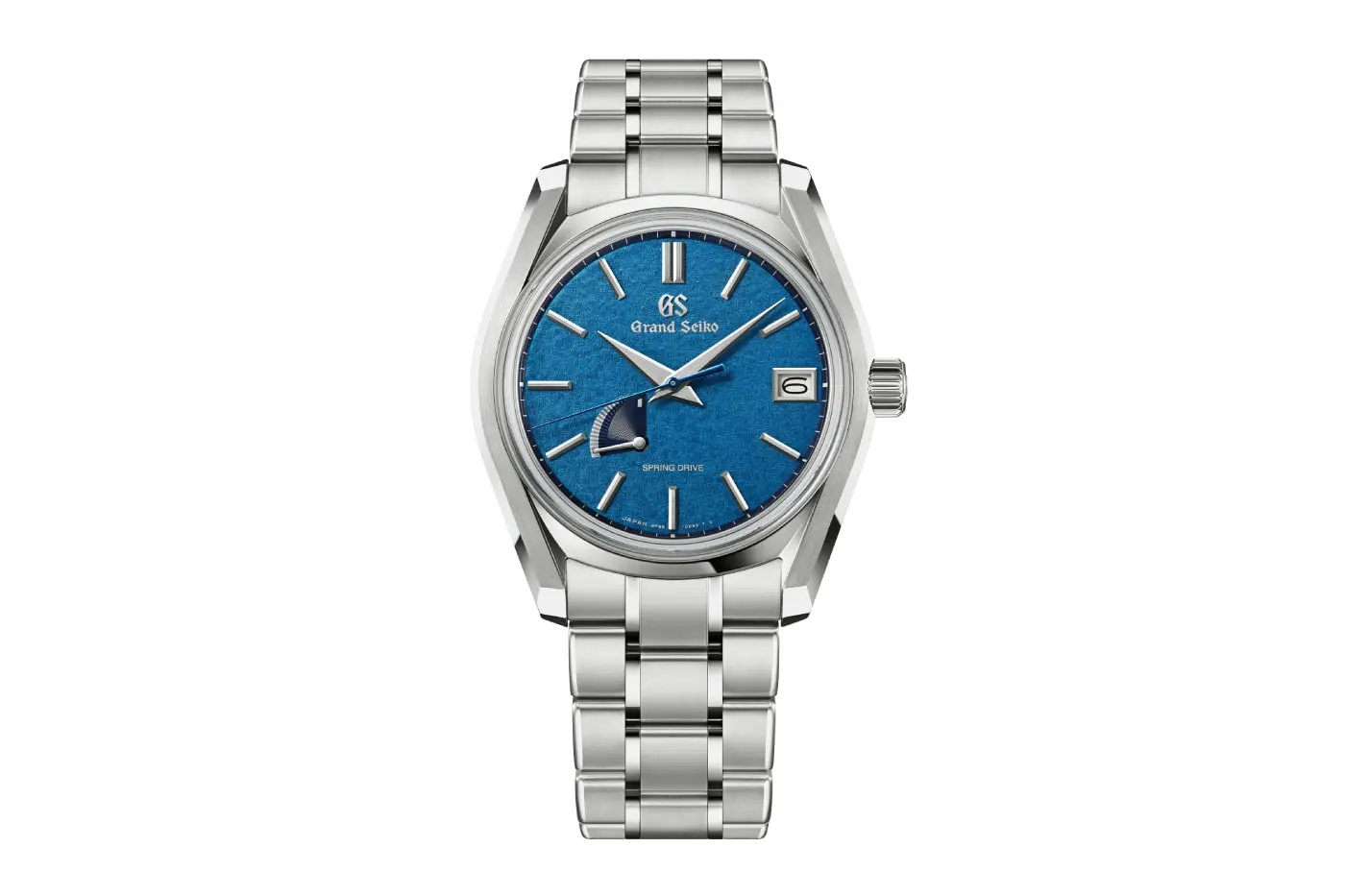
The dial is a deep, oceanic blue, the kind that shifts under light the way water does when the sun drops low over it, and Grand Seiko has built the SBGA527 to reference two specific stretches of coastline eight thousand kilometers apart: the white sand at Shirarahama in Wakayama and the beach at Waikiki in Honolulu. The watch is 40mm, cased in high-intensity titanium, running the Spring Drive Caliber 9R65 movement, priced at $7,600. Fifty exist. All fifty are sold through exactly two doors, both branches of Ben Bridge Jeweler in Honolulu.
This is watch retail treated as diplomatic gesture. The piece commemorates what Grand Seiko calls the Goodwill Beach City Relationship between Shirarahama and Waikiki, a municipal sister-city pairing that exists mostly on plaques and civic websites, not in the vocabulary of people who buy $7,600 watches. Grand Seiko has taken that quiet municipal fact and made it the entire premise of a limited run, distributed nowhere else in the world, not in Tokyo flagship stores, not through the brand's own boutiques, only through a regional American jeweler's two Hawaii locations.
Independent watchmaking has always used scarcity as a language: limited runs tied to anniversaries, movements, or collector clubs. What is unusual here is the scale of localization. Fifty pieces sold through two physical addresses is not a national exclusive or even a regional one. It is a hyperlocal object, built for a single metro area's collector base, using a civic relationship as its narrative anchor rather than a movement innovation or a design lineage. The specialist codes of high horology, provenance, limited numbering, dial storytelling, get compressed here into something closer to a tourism partnership than a watchmaking statement.
Consider what the distribution model asks of a buyer. Someone in Honolulu or someone flying in specifically for the piece has to walk into a Ben Bridge storefront, not a Grand Seiko boutique, not a flagship in Tokyo, to acquire a watch built around a coastline comparison between Wakayama and Waikiki. The brand has effectively outsourced the entire release to a regional American jeweler, which is itself a statement about where Grand Seiko believes its most devoted, locality-obsessed buyers actually live.
The dial's blue, meant to evoke both Shirarahama and Waikiki at once, only works as a selling point if the civic pairing behind it is legible to the person buying the watch. That legibility problem is the real subject here. Grand Seiko is betting that the Goodwill Beach City Relationship, obscure as it is outside municipal government, can carry the emotional weight that movement innovation or design lineage usually carries in high horology. The titanium case and the Spring Drive Caliber 9R65 movement are almost incidental details next to that bet.
What makes the release notable is not the case size or the movement, both of which sit comfortably within Grand Seiko's existing catalog, but the decision to let a sister-city plaque function as the entire narrative engine for a global exclusive. That is a different kind of scarcity than a collector club or an anniversary edition provides, because it does not require the buyer to know anything about watchmaking. It requires only that they know, or learn on the spot, why Wakayama and Honolulu belong on the same dial.
Grand Seiko has run city-specific and boutique-specific limited editions before, but rarely with a premise this narrow: not a country, not a chain, but two doors in one city, sold on the strength of a sister-city relationship that most of the eventual buyers will need explained to them at the counter. The SBGA527 belongs to a growing category of luxury object that treats extreme locality as content rather than constraint. Ben Bridge Honolulu now holds the entire global supply, and Grand Seiko has made two storefronts in Hawaii the exclusive gateway to one of its most narratively dense releases this year.