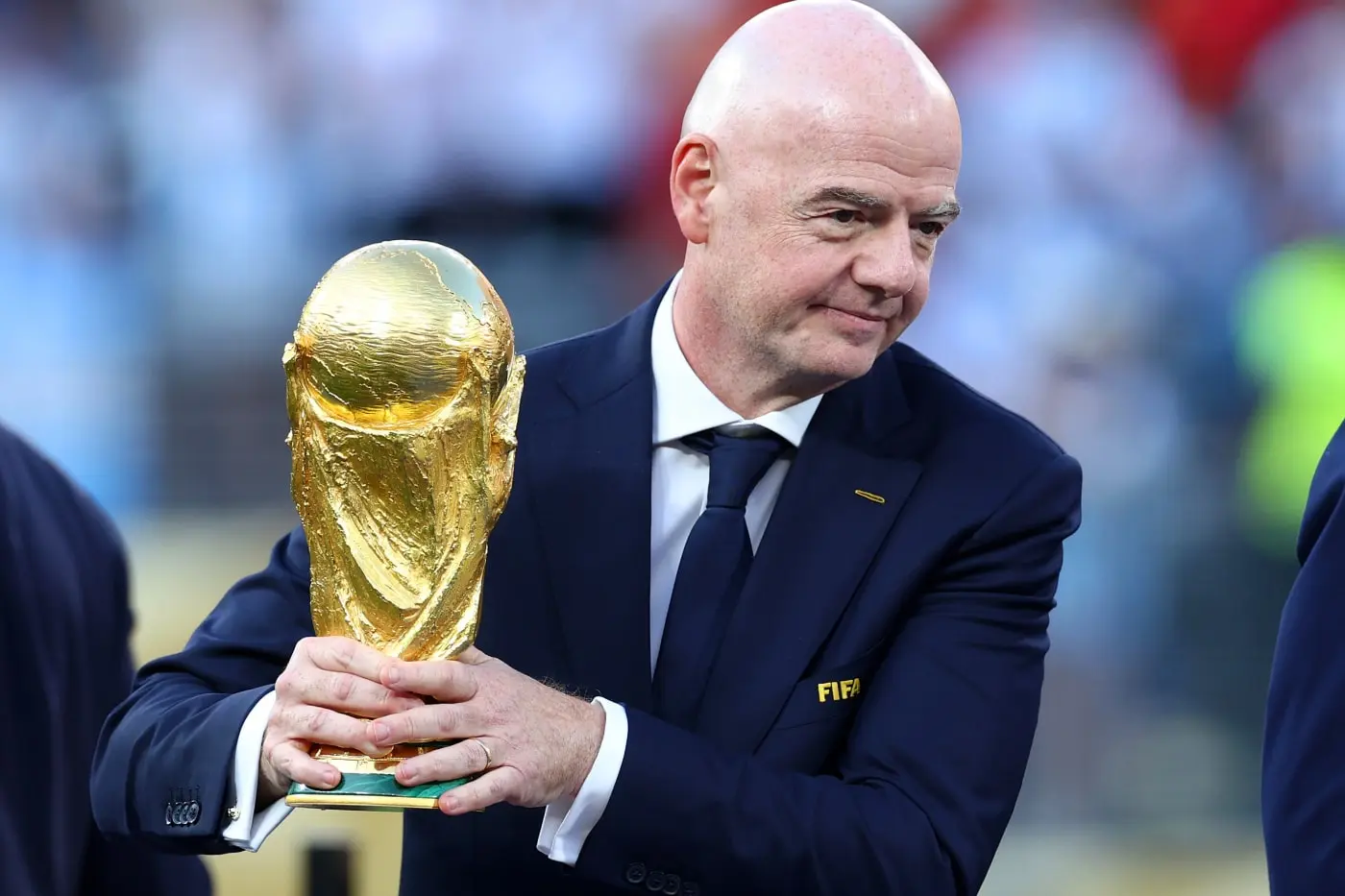
$20 million USD. That is the sign-up payment each federation would contribute under FIFA's Forward Enterprise proposal, according to a 25-page confidential sales deck that surfaced this week. The prospectus names American investor Joshua Kushner as the intended buyer for a 20 percent stake in FIFA's commercial operations.
200 events currently. 450 events proposed. The gap between those figures is where the institutional contradiction sits. FIFA's own medical committee has published repeated warnings about fixture congestion since 2019. The expanded calendar would add 250 annual events to a system the governing body's internal research already labels as unsustainable for player health.
The document was drafted by the same advisory team that structured FIFA's Club World Cup expansion. That project added 32 clubs to a tournament format originally designed for seven. The pattern is consistent: commercial scale first, operational capacity second.
UEFA's response arrived within 48 hours of the leak. The European federation issued a statement referencing "scheduling sovereignty" and the possibility of boycotting FIFA-sanctioned competitions. The language stopped short of formal withdrawal but named specific mechanisms: reduced participation in expanded Club World Cup editions, withheld broadcast inventory, delayed federation dues.
The $20 million federation payment structure reveals the financing model. Rather than securing external capital through traditional private equity channels, FIFA's proposal distributes the capital raise across its own membership. Each federation effectively becomes both investor and customer, paying into a commercial entity whose expansion directly increases their operational burden.
Player union FIFPRO has not yet issued formal comment. The organization's 2024 workload study documented that elite players averaged 72 competitive matches annually, a figure already above the 55-match threshold its medical advisors identified as the injury risk inflection point. A 125 percent increase in global events would push that average higher, assuming proportional player deployment.
The prospectus values FIFA's commercial operations at approximately $4 billion USD, based on the 20 percent stake and implied total valuation. That figure exceeds the governing body's last audited commercial revenue by a factor of three. The gap between current operations and projected valuation depends entirely on the expanded event calendar materializing.
Kushner's involvement introduces a capital source with no prior football governance exposure. His firm, Thrive Capital, has historically invested in consumer technology and healthcare platforms. Football's commercial infrastructure represents a category departure.
UEFA's boycott threat carries weight because European leagues supply the majority of broadcasting value for FIFA competitions. The Champions League alone generates more annual revenue than the entire FIFA Club World Cup format. A coordinated European withdrawal would reduce the expanded event calendar's commercial viability before implementation.
The leaked deck includes a timeline: federation approvals by Q4 2026, commercial entity formation by Q1 2027, expanded calendar implementation beginning 2028. The 18-month runway assumes no sustained federation resistance. UEFA's public opposition suggests that assumption may not hold.
FIFA's last major structural change, the 2026 World Cup expansion to 48 teams, took four years from proposal to implementation. The Forward Enterprise timeline compresses that process by more than half while introducing private equity participation for the first time in the organization's 120-year history.
450 events. 200 federations. One investor. The arithmetic of FIFA's proposal converts player welfare into a rounding error on a $4 billion valuation.