The Ryman Auditorium still has its pews. Wooden, church-hard, built for an audience that came to sit still and listen, which is exactly the audience Big Thief got on the night they played Horsepower start to finish: twenty-nine songs, no album yet in stores, no single circulating ahead of the show to prime the room. Lucinda Williams walked out. Gillian Welch walked out. Iris DeMent walked out. The set list did the work a rollout usually does.
This is a full inversion of how a triple album normally reaches an audience. The standard sequence: announce, drop a lead single, let it sit on playlists for a few weeks, tour the record once people already know the words. Big Thief skipped the entire middle of that chain and went straight to the venue, treating the live room as the primary release format rather than the victory lap after one. The audience at the Ryman heard the album before any journalist, algorithm, or fan account had a chance to tell them what to think about it.
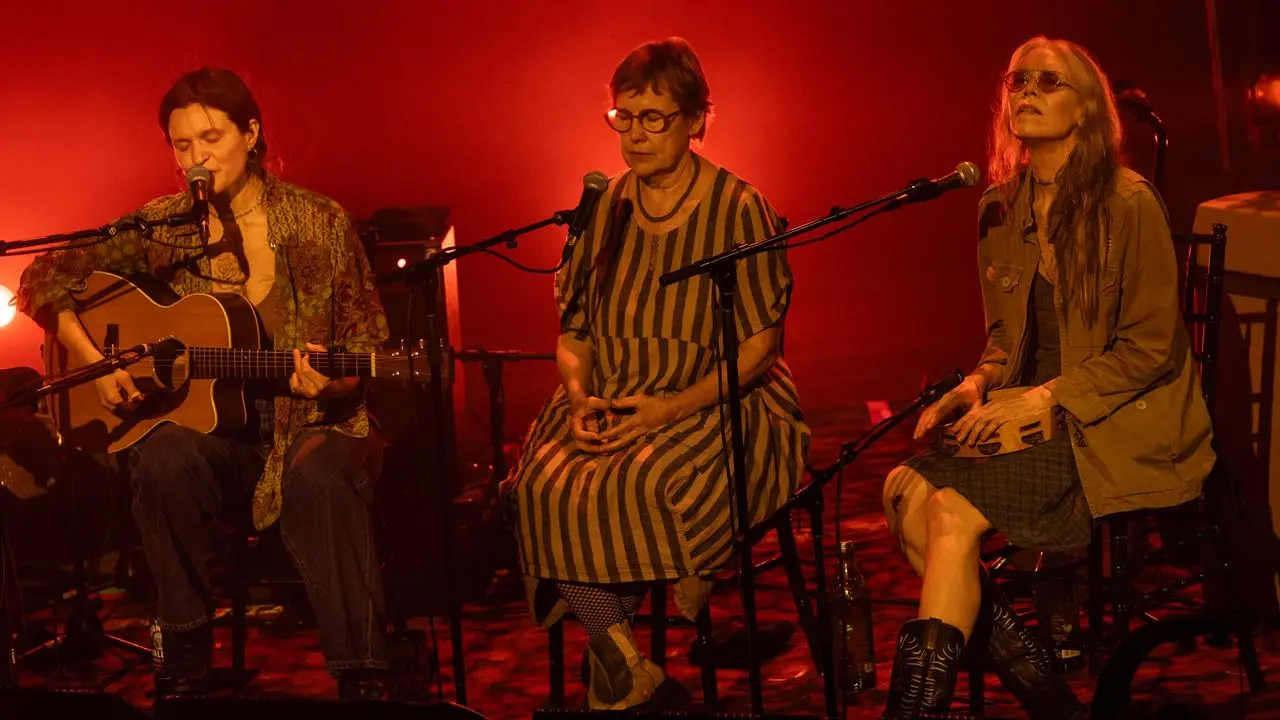
This is folk and Americana retail logic, not pop logic. A pop triple album debuts through a media apparatus built for maximum simultaneous reach: global streaming push, coordinated video content, a press day. Big Thief instead ran the debut through a single room with roughly two thousand seats, the kind of venue that has hosted the genre's elders for a century, and let the songs be judged first by people who paid to be in a pew. The choice of guests reinforces the register: these are not pop features engineered for chart assist, they are three generations of songwriters who function as a credentialing committee for anyone claiming the same lineage.
The gap this exposes is not about quality, it is about sequencing. Most album rollouts today compress the distance between announcement and consumption because the culture around music has learned to move fast, chasing a single before it can even settle into a body of work. Big Thief did the opposite: they let twenty-nine songs exist for one night as a live event only, with no recorded version to check them against, no lyrics genius page to parse in real time. The record becomes, for a moment, un-clippable.
That un-clippable window will not last. Horsepower will eventually stream, get reviewed, get broken into GIFs and captioned highlights, and the live show will recede into being merely the night it debuted. But for one evening at the Ryman, the album belonged entirely to the room it was performed in, and that is a release strategy belonging to the folk revival circuit, not the algorithmic one. Big Thief has placed itself, deliberately, on the wrong side of the internet's clock, and it is the only good place to be standing.