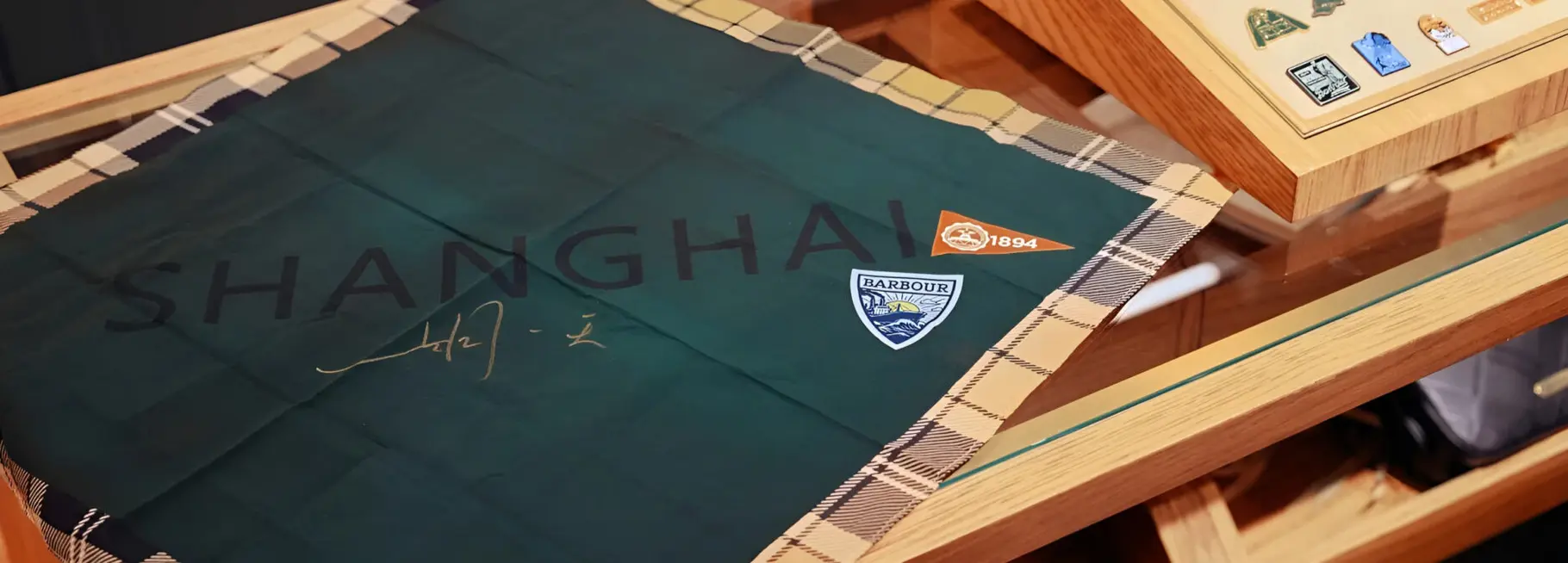
132 years old. That is the age Barbour gives itself in its own materials, the number the brand has built its entire identity around: a wax jacket house from South Shields, England, selling waterproofed cotton to farmers and royals since 1894. On 11 September 2026, that identity opened two doors in Shanghai on the same week. One is a physical flagship. The other is a Douyin storefront, backed by a livestream debut.


The numbers do the explaining an institution's language does not. Barbour's newsroom and retail materials describe the brand in terms of heritage, craft, and continuity: waxed cotton, quilted linings, a design language essentially unchanged for a century. Douyin operates on a different register entirely: same-day product drops, live-hosted sales events, algorithmic discovery, impulse commerce measured in minutes, not decades. Dao Insights reported the flagship and the Douyin debut as a single combined launch, not two separate initiatives run on separate timelines.
This is not the first time a heritage apparel brand has entered Chinese social commerce. It is, however, a compression of the usual sequence. Western heritage labels typically enter China with the flagship first: a controlled brick-and-mortar rollout meant to protect the story the brand tells about itself, years ahead of any livestream retail experiment. Barbour skipped the sequencing. Flagship and Douyin storefront opened in the same week, which means the brand's slowest-moving asset (a century-plus of English provenance) and its fastest-moving retail channel (a platform built for hourly turnover) launched under one press event.
The operational record shows a brand willing to run two speeds of commerce through one launch calendar. Barbour's own materials continue to lead with heritage language: waxed cotton, English weather, three generations of family ownership. Nothing in that language mentions livestream hosts or same-day conversion metrics. The Douyin storefront runs on those metrics by design. One brand, two clocks, one week.
The sequencing question matters because it exposes what the flagship and the storefront are each built to protect. A flagship exists to control pace: visitors move through waxed cotton and quilted linings at whatever speed the story requires. A livestream storefront exists to eliminate pace as a variable entirely, converting attention into a sale before the viewer has time to reconsider. Running both under one press event means Barbour is no longer choosing between those two logics. It is asking them to coexist inside a single launch calendar.
Dao Insights treated the combined launch as one story rather than two, and that framing is itself informative. A heritage house that wanted to keep its provenance narrative insulated from algorithmic retail would have staggered the openings, letting the flagship's press cycle finish before the Douyin debut began. Barbour did not do that. The choice to open both doors in the same week suggests the brand sees no real separation left to protect, that the English weather and the family ownership and the century of waxed cotton are now simply inputs into whatever channel moves fastest.
What the operational record does not settle is which clock ends up governing the other. A flagship can absorb a livestream's urgency without losing its own pacing, or a livestream's urgency can start dictating what the flagship emphasizes next season. Barbour's own materials give no indication yet of which direction that influence runs, only that the brand has now put both clocks in the same room and called it a single launch.
132 years of positioning met one Douyin debut on 11 September 2026. The gap between those two numbers is now retail strategy, not an inconsistency to be resolved.