Teddy Santis treats Porsche like a canvas. The first collaboration was a 1990 964 Carrera 4 in 2020. Since then: a 1977 911 SC in 2021, a 1960 356B in 2023, and a 1994 993 Turbo in 2024. Four cars, four years. The arrangement is less a product partnership than an extended meditation on a single question, which is what an old Porsche looks like if a designer from Queens had been in charge of it.
The strange part is that Porsche, for all its newsroom output and cultural confidence, has never let these builds carry the brand the way they could. Ask around about Porsche special editions and the answer is the 911 R and the GT3 RS, not the Santis cars. The company that built the brand asset for auto culture is still slightly awkward at publishing the cultural editions that actually affect how young people see the marque.
The four builds, in order.
Three of the four builds, photographed by Aimé Leon Dore's studio: the olive 911 SC safari, the Midnight Blue 356B, and the Mulberry Green 993 Turbo. Each is technically an Exclusive Manufaktur one-off. In practice they read as chapters in a single, coherent argument about American taste applied to German machinery. The opening 964 Carrera 4 from 2020 sits in the body copy above, with press coverage held privately.


Part of why Porsche has kept these builds quiet is organisational. Porsche Exclusive Manufaktur, the bespoke arm, is structurally separate from Porsche's corporate communications. The ALD cars are Exclusive Manufaktur projects, one-off, heritage-adjacent. They get a short newsroom note and a careful press release and then they disappear into private collections. The marketing budget lives elsewhere, attached to the current model year, and current model year marketing does not talk about 964s.
The design language, up close.
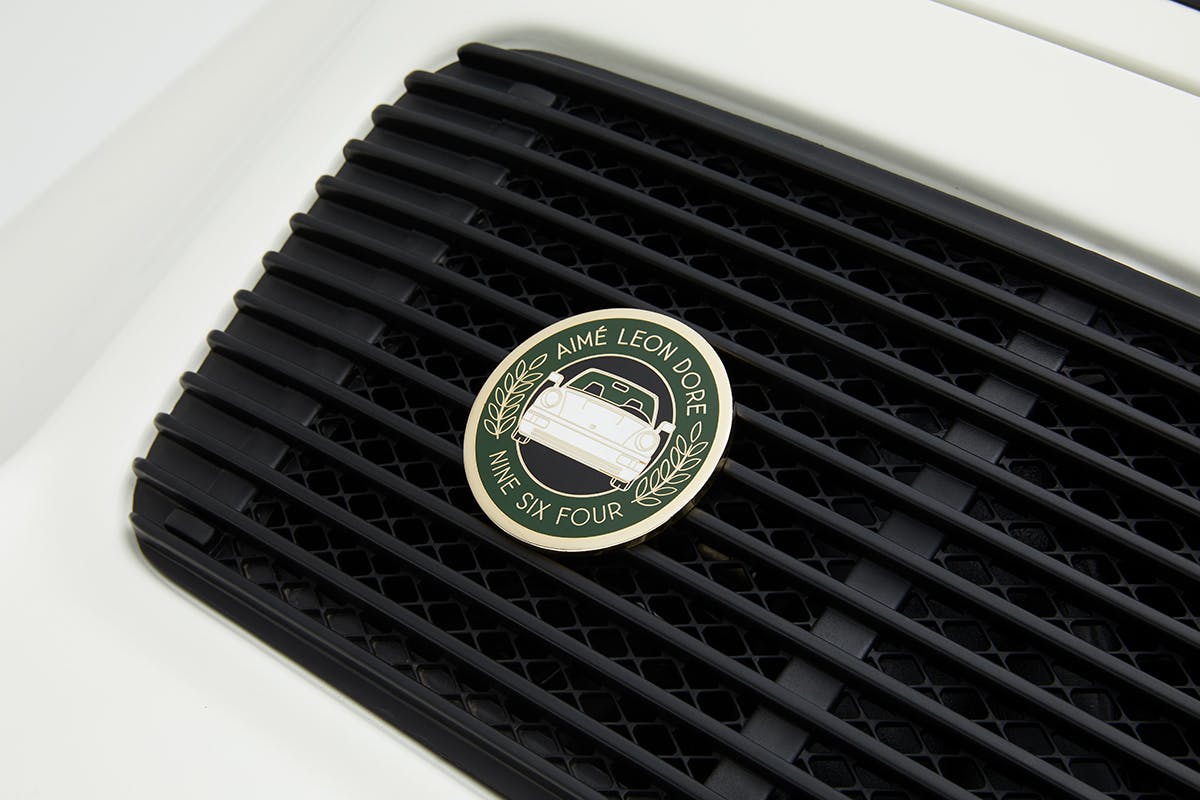
Every Santis Porsche shares a detail vocabulary that is specific enough to be identifiable at the level of a wheel nut. The palette is American, the restraint is Italian, the wheels are almost always from a narrow shortlist of Fuchs references.

The cultural consequence is that the Santis Porsches have been adopted as evidence of ALD's taste, not as evidence of Porsche's willingness to work with it. Porsche, as a brand, gets the financial return, the Exclusive Manufaktur margins are formidable, but forgoes the cultural return, which is the more compounding asset. This is the inverse of the Hermès-Carhartt dynamic, where Hermès has let the collaborations carry the brand into streetwear in a way Carhartt WIP could not have done alone.

What Porsche is leaving on the table
Porsche could, if it chose, make the ALD collaborations the spine of its cultural communications to buyers under forty. The newsroom could publish long-form stories on each build, the official social could carry them, the bespoke Exclusive Manufaktur business could be turned into a visible program rather than a discreet one. None of this requires Porsche to do anything structurally different; it just requires the company to treat the cultural work as newsworthy on the same terms as the new Cayenne.
That Porsche has chosen not to do this is probably a choice, not an oversight. German corporate communications tend to treat bespoke work as private business, even when the buyers and the designers are actively publicising it. The result is a gap between Porsche's own newsroom output and the cultural air the brand actually breathes.
The ALD collaboration is the most important Porsche-adjacent cultural work of the last five years. It is also the least amplified by Porsche itself.