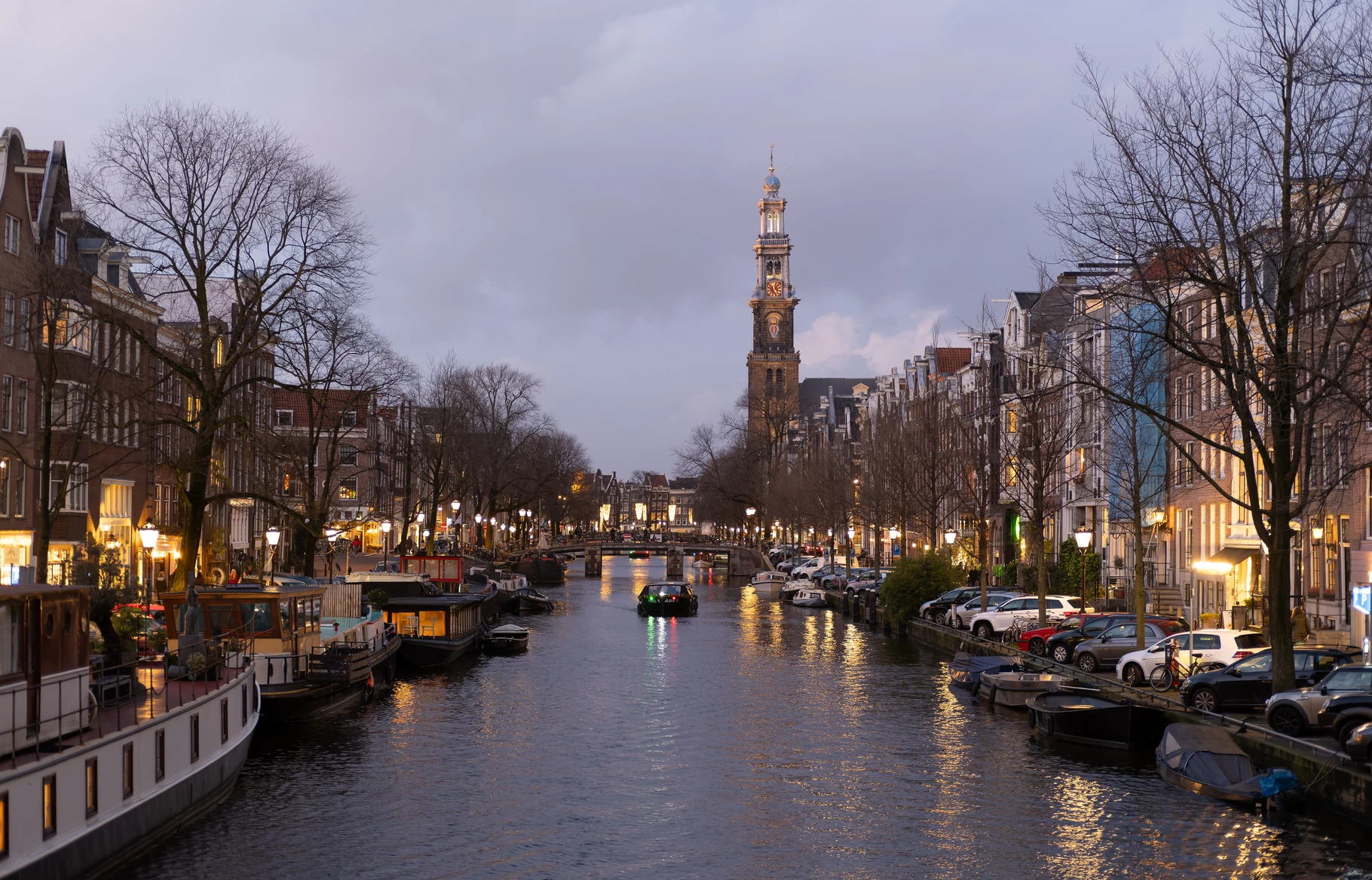
The Westerkerk, the 17th-century Protestant church on the Prinsengracht, is weighing plans to open an underground visitor centre in its crypt. The proposal, reported by Het Parool this week, would create an accessible space beneath the nave to tell the story of the thousands of Amsterdammers once buried there, including, probably, Rembrandt van Rijn.
The pitch is framed as heritage recovery. Church administrators note that the Westerkerk's floor once held the remains of figures whose works now hang in the Rijksmuseum: painters, cartographers, anatomists, guild masters. "Half the Rijksmuseum was buried here," the church's spokesperson told Parool, invoking a direct line between the crypt and the national collection across the city.
That framing is revealing. The Westerkerk has not functioned primarily as a worship space for most visitors in decades. It is a Jordaan landmark, a canal-belt icon, the tower Anne Frank wrote about hearing from the Achterhuis. Sunday services still run, but the building's public identity orbits tourism and commemoration rather than Reformed practice. A crypt visitor centre does not represent a new direction. It names the direction the institution has already been travelling.
The Rembrandt connection is the centrepiece. The painter was buried in the Westerkerk in 1669, though his exact grave site is unknown. No marker survives. In the 18th century, the church cleared its floor burials, bones moved to mass graves or lost entirely. A crypt exhibition would have to reckon with absence, not presence: Rembrandt is there in theory, in probability, but not in verifiable material form.
That tension, between institutional claim and evidentiary gap, mirrors a broader pattern in Amsterdam's heritage economy. The Anne Frank House draws 1.3 million visitors annually to a building defined by what is no longer there. The Rembrandthuis on Jodenbreestraat reconstructs a studio environment the painter himself vacated in 1656. The Westerkerk crypt would add another node to a circuit where significance is asserted through association rather than artifact.
For the church itself, the drift is structural, not just rhetorical. Mainline Protestant attendance in the Netherlands has declined for half a century. The Westerkerk's congregation is small; its building is large and expensive to maintain. Heritage programming, ticketed tours, concert series: these are not sidelines. They are the operational core that keeps the building solvent.
The crypt proposal makes that reality architectural. A visitor centre beneath the nave is not a chapel or a columbarium. It is exhibition infrastructure, the kind of space that requires climate control, lighting rigs, interpretive signage, and a queuing system. If approved, the Westerkerk will have built, literally underground, the museum it has been becoming above ground for years.
None of this is necessarily lamentable. Churches across Europe have repurposed themselves as concert halls, bookshops, climbing gyms, and residential lofts. The Westerkerk's path, into heritage attraction, is gentler than most. But the language around the crypt proposal, the invocation of the Rijksmuseum, the emphasis on Rembrandt, deserves notice. It is not a church asking how to serve its congregation. It is an institution asking how to narrate its adjacency to more famous institutions, and how to monetise the bones it can no longer locate.
The plans remain preliminary. Funding, permits, and archaeological surveys stand between proposal and construction. But the direction is set. The Westerkerk is not drifting toward becoming a museum. It is acknowledging that the drift already happened, and asking what to build next.