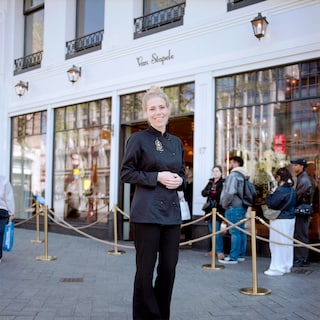
Vera van Stapele, founder of the Staalstraat cookie shop that bears her name, told Het Parool that she has searched Google for a specific query: how can you get fewer customers? The statement sounds like a joke. It is not. Van Stapele's shop has operated at capacity for years, with queues that snake down the narrow street and wait times that stretch past an hour on weekends. The product, a single chocolate cookie baked fresh and sold warm, has become one of Amsterdam's most photographed edible items. The problem, from her perspective, is that the attention exceeds the operation she wants to run.
This is the inverse of the hospitality playbook. Most operators spend their early years chasing visibility, courting press, building social proof, and hoping the queue materialises. When it does, they typically scale: more locations, longer hours, wholesale distribution, brand extensions. Van Stapele has done none of that. The shop remains a single room. The menu remains a single item. The hours remain limited. The queue, which she did not seek, persists anyway.
The preference gap here is instructive. The shop is named everywhere: travel guides, social feeds, algorithmic recommendations. It is chosen constantly: the line exists. But the founder's stated goal is for it to be chosen less. That gap, between presence and preference, between visibility and intention, is the structural tension of the business. Most brands would call this a scaling opportunity. Van Stapele calls it a problem to solve.
Her attempts to manage demand have included refusing press requests, avoiding social media, and declining to expand. None of these tactics have reduced the queue. The product's visibility is now self-perpetuating, driven by visitor posts rather than by any strategy she controls. The queue itself has become the attraction as much as the cookie. Tourists photograph the line before they join it.
The hospitality industry in Amsterdam is watching a version of this play out across categories. The city's most visible food establishments are increasingly defined not by the operator's ambitions but by the audience's behaviour. A restaurant that wants to serve a neighbourhood ends up serving a tourism economy. A bar that wants to stay small ends up on a list. The operator's intent and the market's response decouple, and the business must decide whether to adapt to the demand or resist it.
Van Stapele has chosen resistance. The shop will not franchise. The cookie will not ship. The hours will not expand. This is not a marketing strategy dressed as authenticity. It is an operational limit treated as non-negotiable. Whether that limit holds as Amsterdam's tourism pressure continues to rise is an open question. What is not open is the fact that she is one of the few operators in the city asking the question out loud: how do you get fewer customers, and why is the answer so difficult to find?