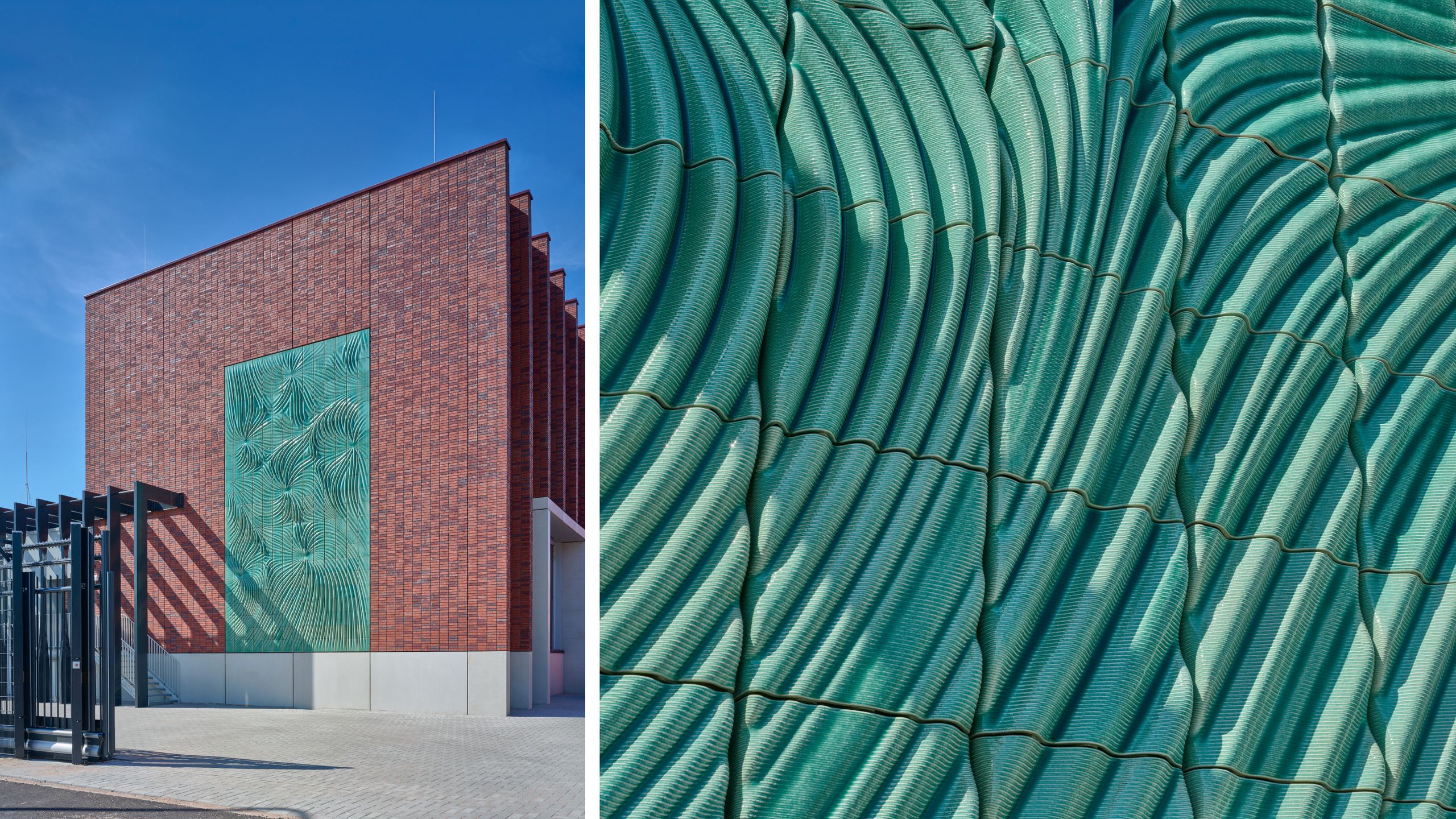
The Netherlands runs on tens of thousands of electrical substations. Most sit behind chain-link, tagged with warning signs, designed to disappear. One of them, a TenneT transformer station in Beverwijk, now carries an eight-by-five-metre ceramic skin that does the opposite: it makes the building's function legible as form.
Rotterdam's Studio RAP completed the installation, titled Powerwall, using a robotic extrusion process the firm has refined over the past half-decade. The technique deposits liquid clay in continuous lines, building up three-dimensional surfaces tile by tile. Each module is unique, calibrated by algorithm to simulate the electromagnetic fields that pulse through the substation behind the wall. The pattern reads as a frozen waveform, ridges and troughs catching light differently across the day.
The commission came from TenneT itself, not from a municipality or cultural fund. That origin matters. Grid operators across the Netherlands face a public-relations bind: they need to build more substations to handle electrification demand, but every new box in a residential neighbourhood draws objections. TenneT's response, hiring a design studio known for computational craft, reframes the problem. The substation is no longer an imposition to screen with hedges. It becomes a marker, a piece of public furniture that acknowledges its own presence.
Studio RAP's trajectory prepared them for the brief. Founded in the mid-2010s by Wessel van Beerendonk and Lucas ter Hall, the practice built its early reputation on parametric facades and pavilions, work that treated digital fabrication as spectacle. Over the past three years, the studio has shifted toward infrastructure clients: transit authorities, energy companies, institutions that commission at scale but rarely invite aesthetic ambition. Powerwall is the clearest result of that pivot. The tiles are not the building itself; Powerhouse Company designed the station, and Studio RAP's wall arrived as a separate commission, mounted on the brick facade as permanent work.
The material choice carries its own argument. Fired ceramic is ancient, durable, and legible as craft even when produced by robot. Studio RAP's process does not hide the machine. Extrusion lines remain visible, each tile bearing the trace of its making. The effect is somewhere between Delftware and industrial tubing, a hybrid the firm has pursued across several projects. For a substation, the combination lands well. The wall reads as both permanent and strange, infrastructure that admits it was designed rather than merely engineered.
TenneT has not announced further commissions, but the logic of the pilot is clear. The Netherlands will add thousands of substations over the coming decade. If even a fraction receive this treatment, Studio RAP's drift from pavilion design to utility architecture will have opened a new category: infrastructure ornament, publicly funded, algorithmically generated, fired in clay.