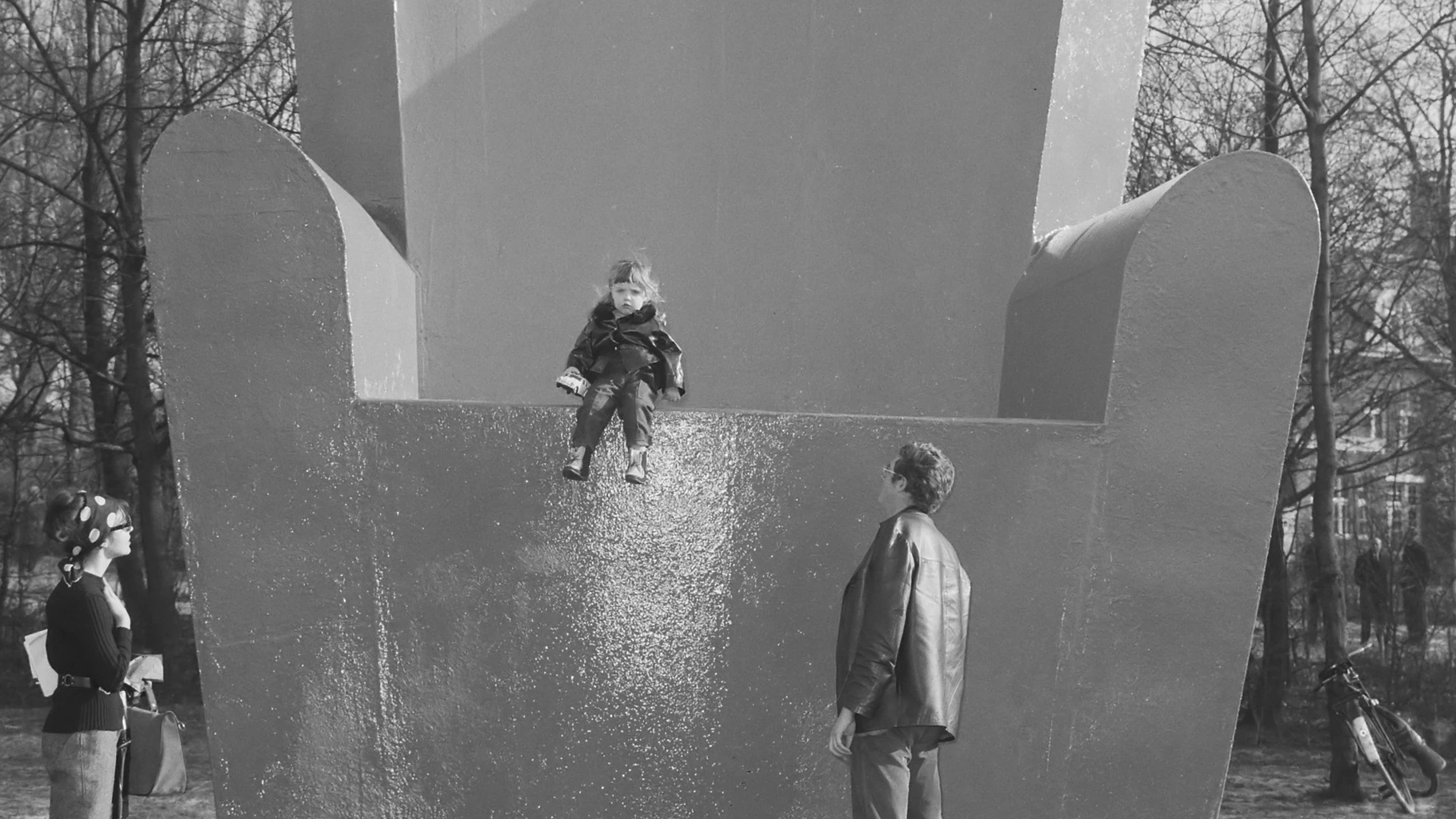
The Stedelijk Museum Amsterdam is showing what it calls the final work of Wim T. Schippers, the Dutch conceptual artist who has spent six decades testing the boundaries between prank, art, and institution. The work, titled "Wim is weg" (Wim is gone), opened this week. The museum that once had to clean peanut butter off its gallery floors is now staging the artist's exit.
The institutional relationship between Schippers and the Stedelijk is one of the longest continuous dialogues in Dutch contemporary art. Schippers first exhibited in the museum's orbit in December 1962, when Museum Fodor, the annexe where the Stedelijk showed Amsterdam artists, hosted the A-dynamic group's rooms of salt and broken glass, works that treated the gallery as a site for interventions rather than display. His peanut butter floor, conceived in 1962 and first executed in 1969 at the Mickery gallery in Loenersloot, forced any institution that held it into the position of conservator and janitor simultaneously. The work asked whether an institution could hold something designed to spoil, stick, and smell.
What the Stedelijk is now presenting is the inverse question: what happens when the artist announces his own disappearance while the institution remains? "Wim is weg" positions the museum as the surviving party in a relationship that began with the artist's provocations and ends with his declared absence.
The drift here is structural. The Stedelijk has moved from receiving Schippers's interventions to actively framing his departure. The museum is no longer the target of the work but the narrator of it. This shift mirrors a broader pattern in how Dutch institutions have repositioned themselves relative to the conceptual artists they once struggled to accommodate. The Kröller-Müller did something similar with Jan Dibbets in 2021, realising landscape constructions he had drawn in 1967 and 1968 but never built, moving from collector to interpreter. The Van Abbemuseum built the Play Van Abbe cycle of 2009 to 2011 on the same arc, turning its own collection and institutional history into the subject of the show.
Schippers's career sits at a specific intersection in Dutch cultural history. He emerged from the same moment as Wim Crouwel and the Total Design generation, but chose absurdity over systems. His television work with "Van Kooten en De Bie" reached mass audiences in ways his gallery practice never could. The gap between Schippers the broadcaster and Schippers the conceptual artist was itself a kind of performance, one the Stedelijk is now collapsing by treating both as parts of a single institutional legacy.
The title "Wim is weg" carries deliberate ambiguity. It could be read as announcement, instruction, or epitaph. The Stedelijk's framing does not resolve this ambiguity but holds it open, which is perhaps the most faithful thing the museum could do with an artist whose entire practice depended on refusing to settle meaning.
The exhibition runs through autumn 2026. For a museum that spent decades trying to figure out how to show Schippers, the answer turns out to be showing his absence. The circle closes not with a retrospective but with a farewell staged by the institution that absorbed his provocations longest.