The Stedelijk Museum has run a corridor commission called Post/No/Bills since long before most of its current visitors held a membership card. The premise has stayed constant across seven editions: hand an artist the passage around the museum's monumental staircase, the connective tissue between galleries rather than a gallery itself, and let them use it as a wall poster once did, fast, temporary, unauthorised in spirit if not in fact. What has drifted, edition by edition, is what counts as a poster.
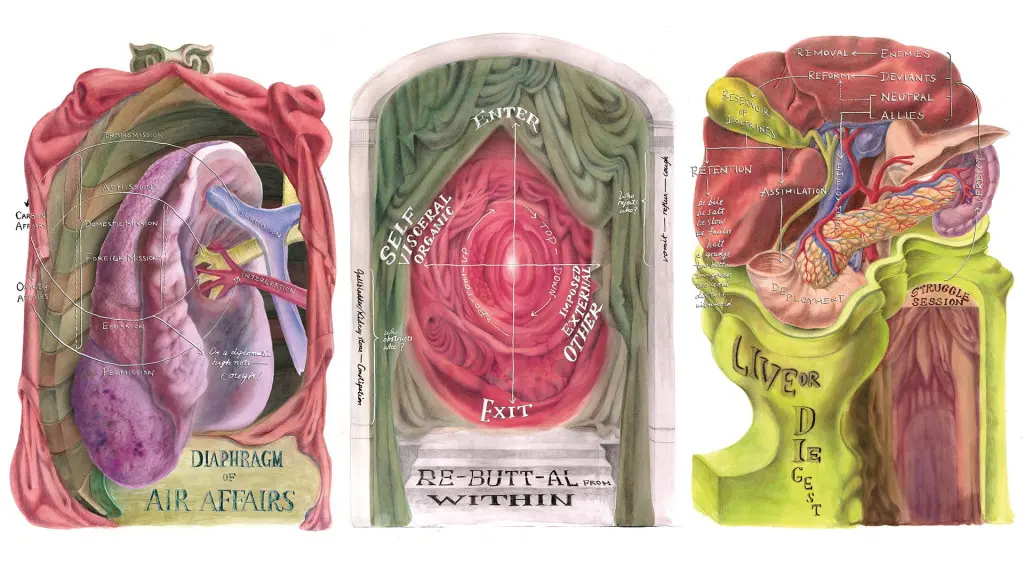
Kexin Hao's contribution, Anatomy of Obstruction, opened this week and abandons the poster format outright. In its place: meters-tall drawings of intestines, lungs, liver, stomach and kidneys, installed in the niches that flank the staircase. The museum's own framing asks the question directly: what if an institution had a body. The organs, per the Stedelijk's release, stand in for how organisations select, order and determine what does and does not get let in. The disruptions to that body, in Hao's reading, represent resistance and contradiction rather than illness.
The move is worth naming because of where it sits inside the series' own history, not because organ imagery is new to contemporary art. Post/No/Bills began as a platform for graphic, print-adjacent work that treated the staircase corridor as a poster wall inside a museum that otherwise polices every centimeter of its walls for conservation reasons. Six editions in, the format has already stretched from flat printed work toward installation. Hao's edition pushes further still: away from the poster's public, disposable register and toward a sculptural, anatomical vocabulary that talks about the museum's internal governance rather than addressing an external public at all.
That is the drift worth flagging. A series built on the idea of the unauthorised street poster, cheap, fast, illicit, has arrived seven editions later at a commission that examines the authorising body itself: what the Stedelijk lets in, what it keeps out, and where inside its own architecture that filtering physically happens. The corridor stopped being a stand-in for the street outside and became a stand-in for the museum's own digestive system. Visitors walking the staircase this autumn are, per the work's own logic, walking through an organ.
The Stedelijk has not said who follows Hao for edition eight, nor when that commission opens. Given the pace of past editions, that decision likely lands with the museum's 2027 programming announcement. What it decides to hang in that corridor next should be read against Anatomy of Obstruction: either edition eight returns to the poster's public register, or Post/No/Bills has permanently become a series about the institution examining itself. Watch what the Stedelijk builds into that corridor next.