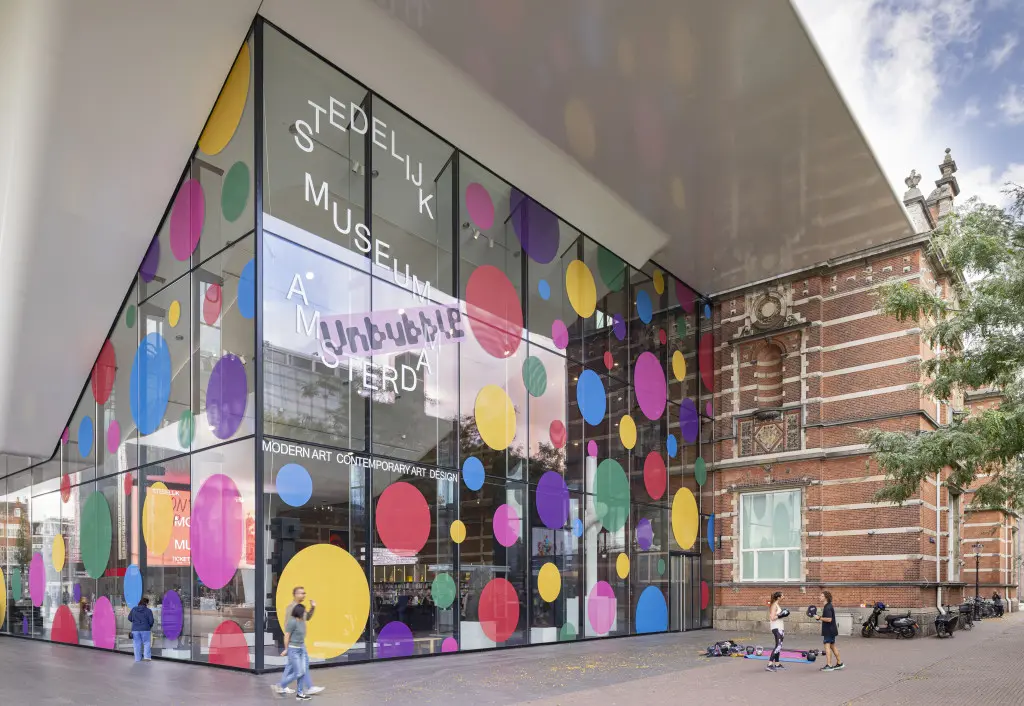
The Stedelijk Museum's facade on Museumplein is covered in colored polka dots this week, nine days before the doors open on the museum's major Kusama retrospective. The museum's own release, published 1 September, frames the gesture as an homage: Kusama died earlier this year, and the institution says the exhibition has taken on "extra meaning" as a result. What the release does not say is when the facade design was commissioned.
A full building wrap by Yayoi Kusama Studio is not a decision a museum makes in the weeks after an artist's death. Facade permits, structural sign-off from the city, and the studio's own approval process for reproducing Kusama's imagery at that scale run on a production calendar measured in months, not days. The tribute framing arrived after the fact. The production did not.
This is the second Stedelijk facade to double as pre-opening marketing this cycle: the museum has increasingly treated its Museumplein exterior as the first gallery visitors see, extending the show onto the square itself. Kusama's outdoor piece, Ascension of Polka Dots on the Trees, will bring the dotted vocabulary further into the plaza, onto the trees standing in front of the building, a move the museum's own materials describe as extending Kusama's visual language beyond the walls.
The sequencing matters more than the tribute language suggests. A campaign this scaled, requiring studio sign-off and fabrication lead time, was locked in long before anyone knew it would double as a memorial. The museum's framing retrofits an emotional register onto a schedule that was set by production logistics, not loss. That gap, between when a decision is made and when the public is told why, is the story the press release does not tell.
The museum's silence on the commissioning timeline is itself a kind of answer. If the facade wrap had been conceived after Kusama's death as a genuine memorial gesture, the release would say so, and would likely say so with pride, citing the speed of the tribute as evidence of the institution's devotion. Instead the release leans on the language of added meaning, a phrase that concedes the plan existed before the meaning did.
The pattern extends beyond this single show. A museum that treats its exterior as the first gallery visitors encounter has already decided that the building itself is inventory, available for extension of the show's visual language onto trees and stone and glass. Ascension of Polka Dots on the Trees is not incidental to that logic. It is the logic, applied to living plants on a public square rather than to a rented facade.
None of this makes the tribute false. Kusama did die. The exhibition does carry different weight now than it would have carried had she lived to see opening day. But the weight was assigned after the schedule was fixed, and the museum's own account of its process, thin as it is, confirms the order of operations rather than obscuring it entirely.
The Kusama retrospective opens 11 September 2026 and runs into the new year. The outdoor installation on Museumplein will stay up for the full run of the show and come down with it. The Stedelijk has turned its forecourt into marketing space, and the museum should say so plainly instead of dressing production logistics up as mourning.