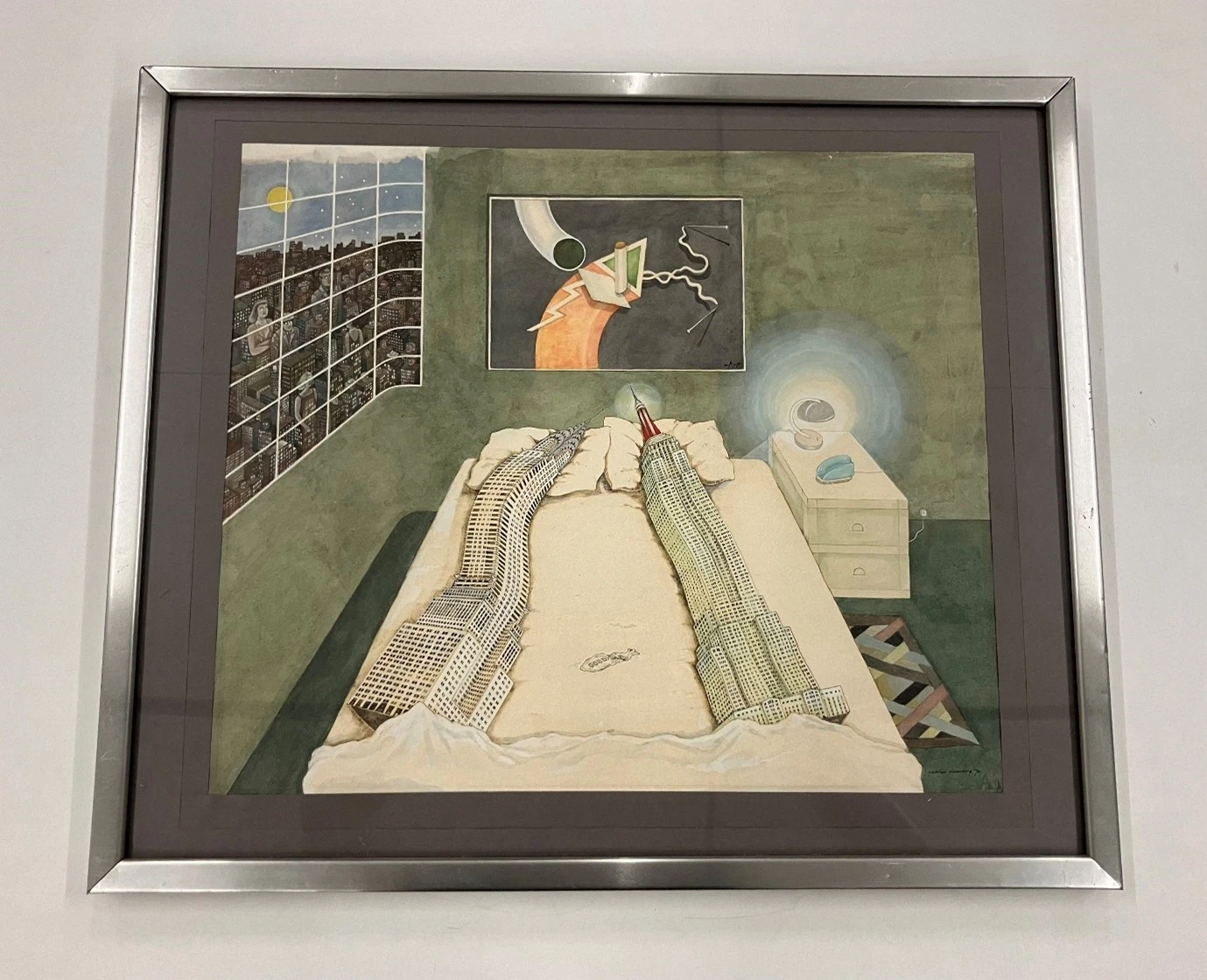
Madelon Vriesendorp is 81 years old and has never had a solo exhibition in a Dutch museum. This changes today, when the Rijksmuseum opens a survey of her drawings in its print galleries. The museum's framing emphasises her humour and surrealist play. What the framing does not emphasise is that Vriesendorp's imagery has been canonical in architecture schools worldwide since the late 1970s, when her paintings and illustrations gave visual form to Rem Koolhaas's theoretical project.
The gap between the work's circulation and its institutional recognition is the story. Vriesendorp co-founded the Office for Metropolitan Architecture in 1975 alongside Koolhaas, Elia Zenghelis, and Zoe Zenghelis. Her painting "Flagrant délit," depicting the Chrysler Building and the Empire State Building in bed together, became the cover of "Delirious New York" in 1978. That image, along with dozens of other Vriesendorp drawings, established the visual grammar that architectural discourse has used to talk about Manhattan, density, and metropolitan ambition ever since.
The Rijksmuseum acquired a selection of her drawings in 2024. The acquisition itself acknowledged what the architecture world has long known: Vriesendorp's work operates at the intersection of illustration, fine art, and theoretical production. It is not secondary to OMA's buildings. It is the means by which OMA's ideas became legible before a single structure was complete.
The lag here is instructive. Vriesendorp's images have been reproduced in architecture monographs, critical anthologies, and university syllabi for five decades. They appear in MoMA's collection and in the CCA's archives. The Dutch institutional apparatus, however, positioned her as a supporting figure rather than a primary voice. The Rijksmuseum exhibition corrects this, but the correction arrives half a century after the work's influence began.
In her interview with Het Parool, Vriesendorp describes herself as "never very serious." The self-deprecation is characteristic but misleading. The drawings on view are technically accomplished and conceptually dense. They operate in a tradition that runs from Piranesi through the Archigram group, using architectural fantasy to critique and expand the discipline's boundaries. The seriousness is in the work, whether the artist claims it or not.
The exhibition runs through September. It occupies the Rijksmuseum's drawing galleries, a space typically reserved for Dutch Golden Age works on paper. Placing Vriesendorp in this context makes a quiet argument: her drawings belong to the national collection not as design ephemera but as art. The museum has taken fifty years to say so out loud.
For Amsterdam audiences, the show offers a chance to see work that has shaped global architectural culture from a position adjacent to that culture's centres. Vriesendorp left the Netherlands decades ago, but the work she produced with OMA in those early years set terms that are still being negotiated. The Rijksmuseum's decision to exhibit her now, with Vriesendorp at 81, registers as institutional catch-up rather than discovery. The work did not need the museum's validation to circulate. The museum needed the work to complete its account of Dutch visual culture in the late twentieth century.