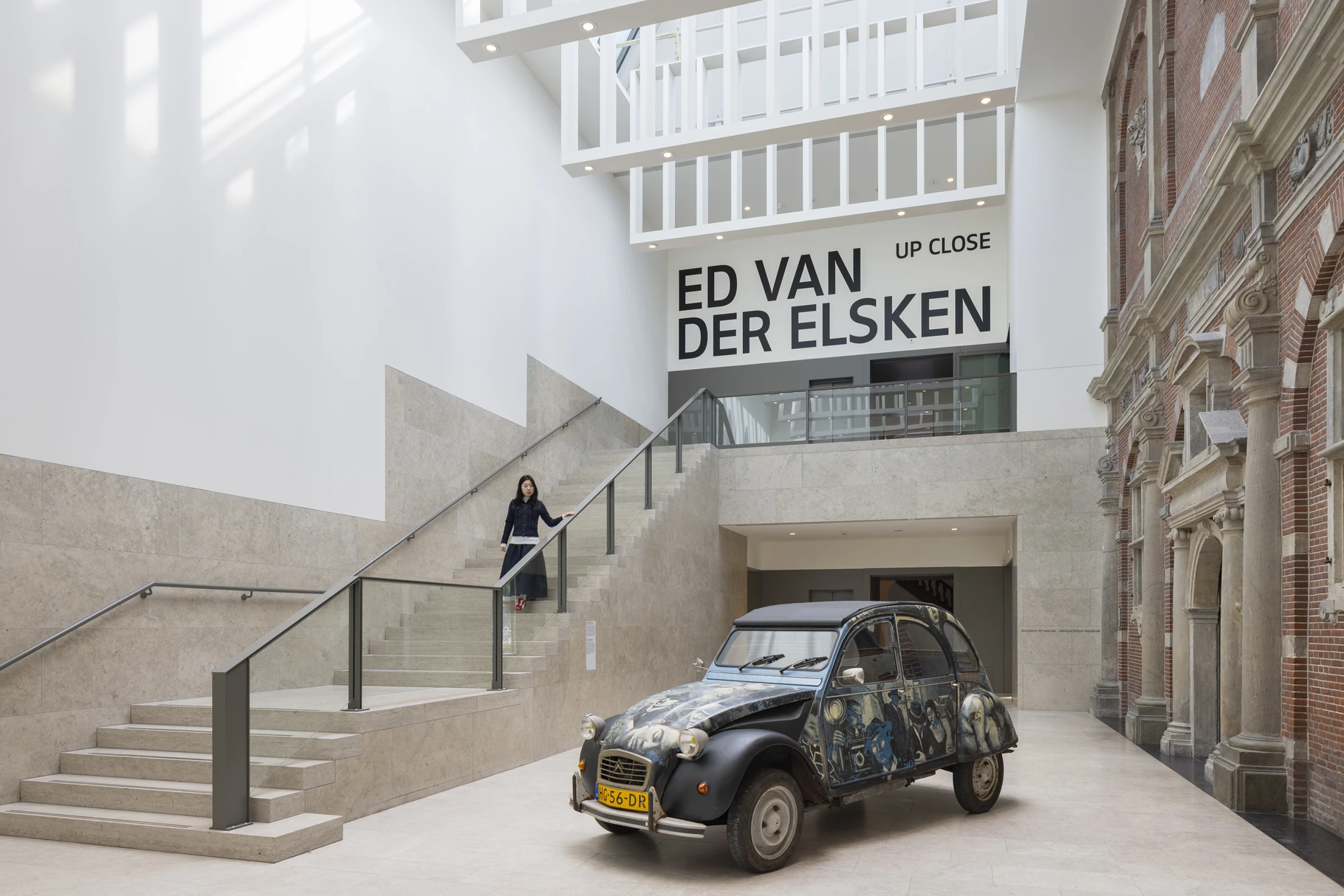
The Rijksmuseum is preparing a major Ed van der Elsken exhibition, the museum's conservator revealing new insights after years of archival research into the photographer who defined Amsterdam's post-war visual identity. The announcement positions the national museum to finally claim an artist whose work has circulated through international institutions and commercial galleries for decades while remaining peripheral to the Rijksmuseum's programming.
Van der Elsken, who died in 1990, built his reputation photographing Amsterdam's bohemian quarters, the red-light district, and working-class neighbourhoods with an intimacy that anticipated street photography's documentary turn. His 1956 photobook Love on the Left Bank, shot in Paris, established his international profile, but his Amsterdam work, spanning the 1950s through the 1980s, became the template for how the city photographs itself. The visual grammar of Amsterdam nightlife, the candid portrait style that dominates Dutch magazine photography, the elevation of ordinary street scenes to art-historical subjects: Van der Elsken's fingerprints are everywhere, absorbed so completely that the source often goes unnamed.
The Rijksmuseum's institutional lag is notable. The Nederlands Fotomuseum in Rotterdam has held the Van der Elsken archive since 1993 and staged multiple exhibitions drawing on his contact sheets and correspondence. International institutions from the Jeu de Paume in Paris to the Art Institute of Chicago have presented his work. Stedelijk Museum Amsterdam mounted a Van der Elsken show in 2017. The Rijksmuseum, which positions itself as the definitive repository of Dutch cultural achievement, is arriving after the field has been thoroughly worked.
That arrival, however, carries weight the earlier exhibitions could not. The Rijksmuseum's curatorial frame, its placement of Van der Elsken within the broader arc of Dutch visual culture, will shape how a generation of visitors understands his position. A photographer long categorised as street documentarian, bohemian chronicler, or magazine contributor now enters the same institutional space as Rembrandt and Vermeer. The question is whether the framing elevates the work or domesticates it, whether the museum's prestige clarifies Van der Elsken's achievement or smooths the edges that made it uncomfortable.
The conservator's claim of "new insights" suggests the museum is building an interpretive framework distinct from prior shows. Years of archival research implies access to materials, correspondence, or prints that previous exhibitions did not foreground. Whether those insights concern Van der Elsken's technique, his editorial relationships, or his position within Dutch photography's institutional history remains unclear. The Rijksmuseum has not announced exhibition dates or confirmed which works will appear.
What the announcement does confirm is the museum's continued expansion beyond its historical painting collection into photography, design, and contemporary practice. The Van der Elsken project joins recent programming around Madelon Vriesendorp, Carel Visser, and other figures who operated at the margins of the museum's traditional scope. The pattern suggests a Rijksmuseum actively repositioning itself as a comprehensive Dutch cultural institution rather than a painting museum with annexes.
For Amsterdam, the exhibition will likely function as civic affirmation, the city recognising its own streets in the national collection. For photography, the institutional validation arrives at a moment when Van der Elsken's influence is so diffuse it requires curatorial archaeology to trace. The lead time between the work and its full institutional recognition now exceeds thirty-five years. Whether that gap reflects the museum's conservatism, photography's slow climb up the fine-art hierarchy, or Van der Elsken's own resistance to institutional capture depends on which story the exhibition chooses to tell.