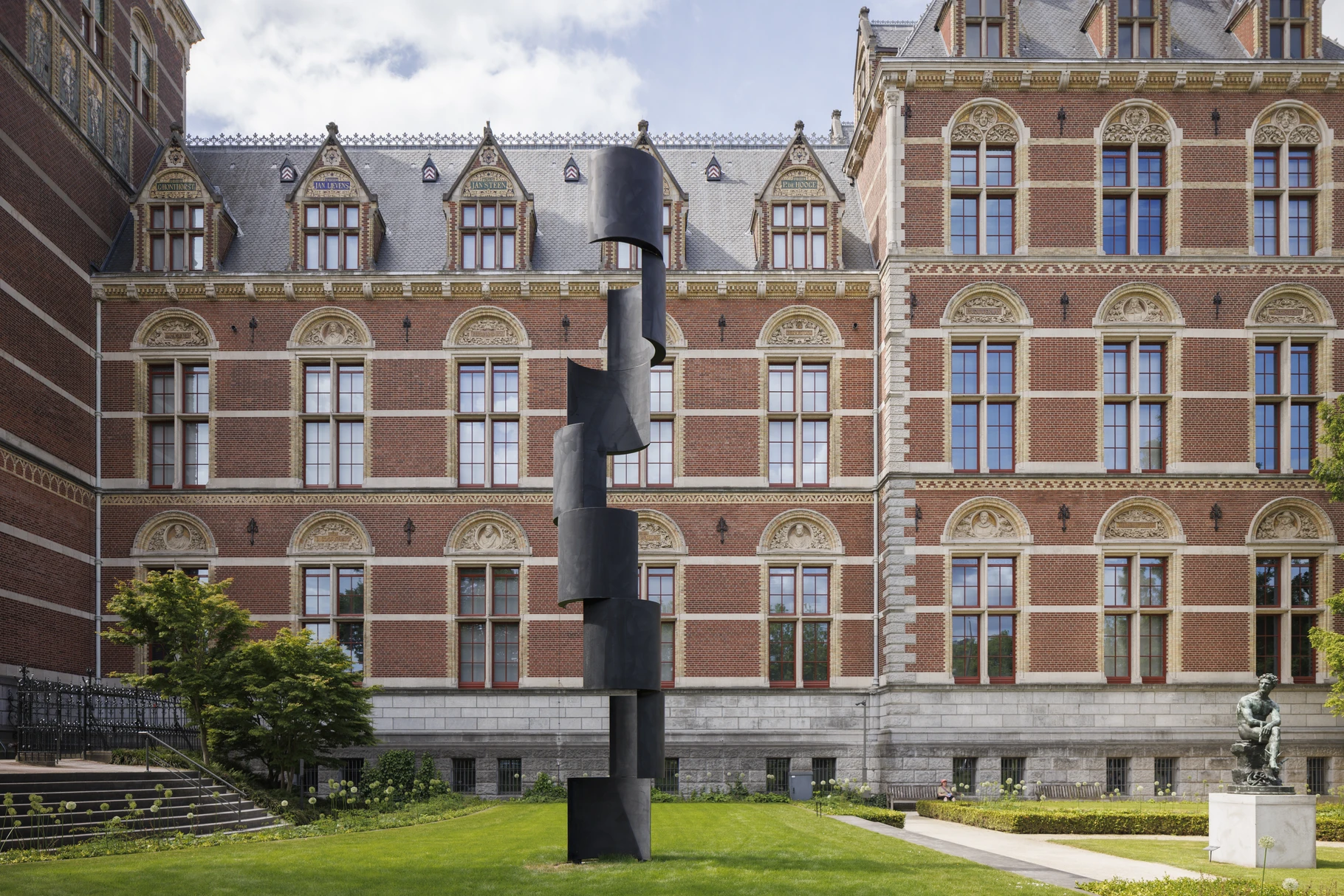
The Rijksmuseum has installed a selection of sculptures by Carel Visser in its gardens, placing post-war Dutch abstraction in the same institutional frame that houses the Night Watch. The works, fabricated from steel, iron, and industrial remnants across Visser's six-decade career, now occupy the manicured hedgerows and gravel paths that 2.5 million annual visitors walk through to reach the main galleries.
Visser, who died in 2015 at 87, built his practice around what he called structural thinking: finding forms in bird skeletons, river deltas, insect exoskeletons, and industrial detritus. His method involved welding found steel into configurations that held tension between organic reference and geometric reduction. The Rijksmuseum presentation includes works from the 1950s through the 2000s, spanning his shift from figurative bronze to the open iron lattices that became his signature.
The placement reads as institutional drift. The Rijksmuseum's core identity remains its Golden Age paintings, the Rembrandts and Vermeers that anchor the building's international reputation. But the gardens have become a secondary programming venue over the past decade, hosting temporary installations that would not fit the interior galleries' permanent-collection logic. Last year, the museum mounted a Madelon Vriesendorp presentation in the Philips Wing; the gardens now extend that willingness to hold work outside the seventeenth-century frame.
The pattern is not unique to Amsterdam. Major European painting museums have increasingly used their outdoor spaces as sculpture venues: the Louvre's Tuileries, the Prado's Buen Retiro extension, the National Gallery's Trafalgar Square partnerships. The logic is partly operational, since sculpture installations require less climate control and allow programming without displacing permanent collection works. But the effect is a slow redefinition of what these institutions hold. A museum known for painted surfaces becomes a museum that also holds spatial objects.
Visser's work fits this drift precisely because it resists the monumental tradition. His sculptures are not bronze commemorations or marble figures; they are welded assemblages that reference natural systems more than heroic narrative. Placing them in the Rijksmuseum gardens suggests a reading of Dutch art history that includes the structural, the industrial, the abstract: a lineage that runs from seventeenth-century still life through CoBrA through post-war welded steel.
The exhibition runs through October. The Rijksmuseum has not announced whether the garden program will continue beyond this installation, but the infrastructure is now in place: pedestals, lighting, signage systems that can rotate new work into the hedgerows. The question is whether the drift continues, or whether this remains a one-season experiment.
For Amsterdam, the installation offers a public encounter with Visser's work that the gallery system rarely provides. His sculptures sit in museum storage and private collections, occasionally surfacing at auction or in retrospective exhibitions. The Rijksmuseum gardens, free to enter and open daily, make the work accessible in a way that the commercial gallery circuit does not. Walk through to see the Vermeer, stay to see the steel.