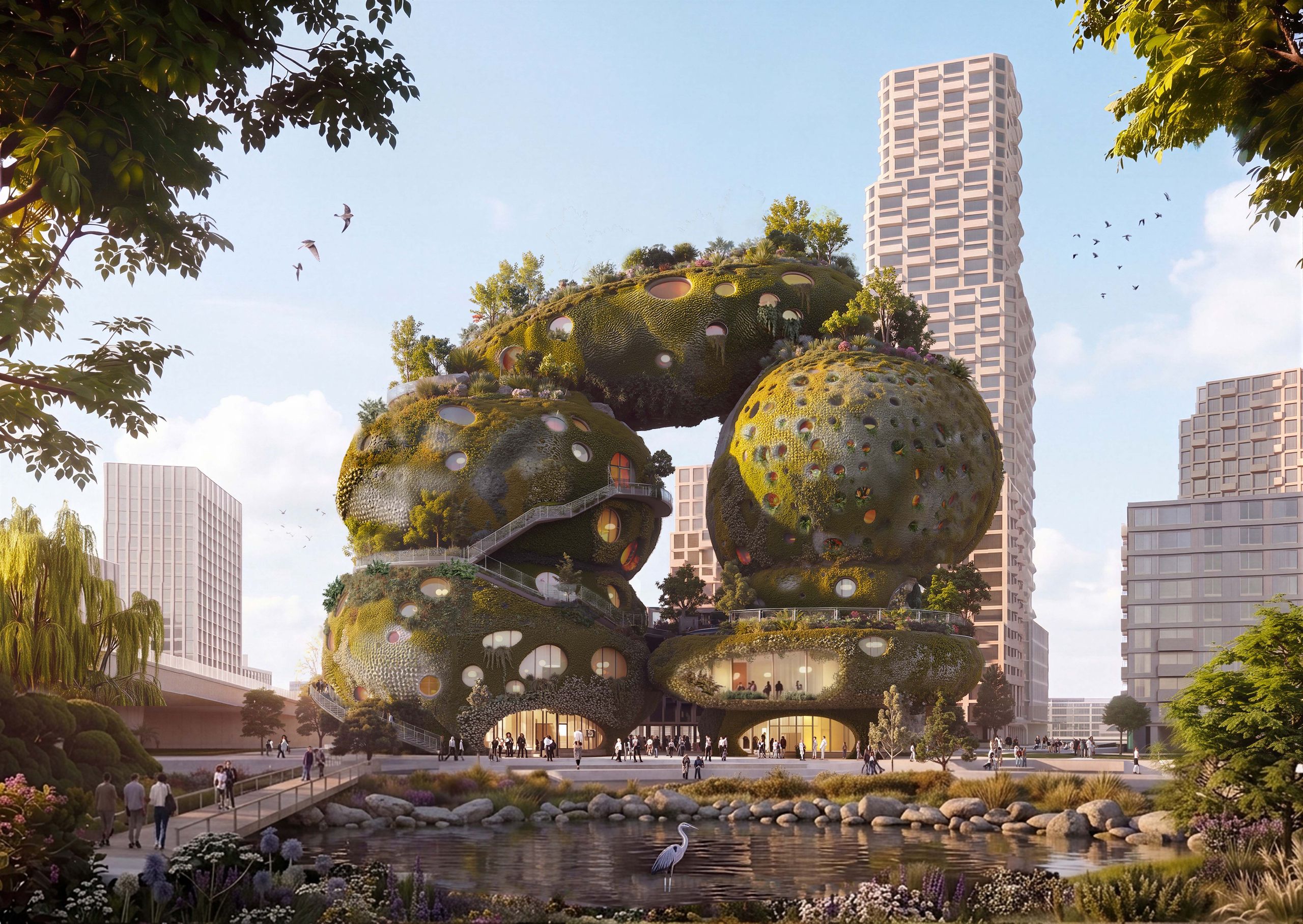
MVRDV has won The Shift International Architecture Competition with Rotterdam Rocks!, a 150-metre sustainable landmark designed to house a hotel, an observation deck, an embassy, and public programming under a single geological silhouette. The jury announced the result on 21 July 2026, selecting the Rotterdam-based firm from a shortlist that included practices from twelve countries.
The brief asked competitors to propose a new 'Wonder of the World' that could anchor a secondary European city's global identity. MVRDV's response literalises the ambition: the tower's massing references eroded cliff faces and stacked boulders, clad in locally-sourced recycite panels that give the structure the texture of compressed sediment. The firm describes the project as 'a mountain for a city built on water.'
Rotterdam's positioning has shifted steadily since the early 2000s. The Erasmus Bridge (1996), the Markthal (2014, also MVRDV), and the Depot Boijmans Van Beuningen (2021) moved the city's image from Europe's largest port to a destination for architecture pilgrimage. Rotterdam Rocks! formalises that trajectory. Where earlier landmarks emphasised engineering or programme innovation, this proposal foregrounds spectacle as civic infrastructure, placing an observation deck at the summit and diplomatic functions in the base.
The embassy component is unusual. The brief did not require it; MVRDV inserted it as a programmatic anchor that would guarantee long-term governmental investment and security maintenance. The firm's competition statement notes that embassies have historically occupied adapted buildings or purpose-built compounds at city edges. Placing one inside a public landmark inverts that isolation, embedding diplomatic presence within a tourist circuit.
Construction timeline remains unconfirmed. The Shift's organisers have stated that the winning design enters a feasibility phase through 2027, with groundbreaking contingent on municipal and private funding alignment. Rotterdam's municipality has not yet issued a formal commitment, though the city's architecture delegate welcomed the result in a statement released hours after the announcement.
For MVRDV, the win extends a pattern. The firm has operated from Rotterdam since Winy Maas, Jacob van Rijs, and Nathalie de Vries founded it in 1993. Its highest-profile commissions have landed elsewhere: the Tianjin Binhai Library (2017), the Valley in Amsterdam (2022), the Seoul Skygarden (2017). Rotterdam Rocks! would return the firm's landmark-scale work to its home city for the first time since the Markthal, twelve years prior.
The competition drew 847 entries. Second place went to a Copenhagen consortium proposing a floating timber pavilion; third to a São Paulo practice with a vertical urban farm. Neither offered the hybrid programme density of MVRDV's submission, and neither addressed the brief's 'wonder' framing as directly. Rotterdam Rocks! treats awe as a deliverable, not a byproduct.
The Shift's jury statement praised the proposal's 'willingness to be monumental in an era suspicious of monumentality.' That suspension of irony is the design's gamble. Rotterdam's postwar identity was built on pragmatic reconstruction; its twenty-first-century identity has been built on functional spectacle. Rotterdam Rocks! asks whether the city is ready for spectacle without the functional alibi.
The feasibility study begins in September 2026.