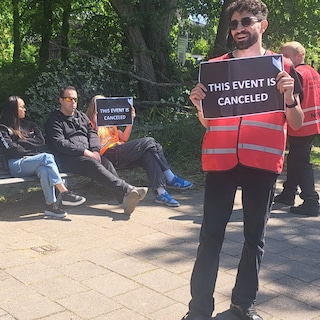
At some point this morning, production trucks were already positioned at Sportpark Middenmeer in Amsterdam-Oost. Thousands of ticketholders were checking train times. And an email was circulating through the offices of the Municipality of Amsterdam that would render all of it irrelevant. Music On, the house festival headlined by Marco Carola and one of the higher-profile international dance events scheduled for the spring calendar, has been cancelled. The city revoked its permit.
The precise grounds for the revocation have not been made public as of publication time. What is public is the timing: a same-day cancellation, announced after stages had been built and before gates had opened. This is not a new pattern in Amsterdam nightlife, but it is accelerating.
The gap between the operational speed of international dance bookings and the administrative tempo of Dutch permitting has been widening for years. Promoters book artists twelve to eighteen months out. Production timelines run on fixed deadlines tied to artist routing and equipment logistics. Permit approvals, meanwhile, move through municipal review cycles that remain calibrated to a pre-consolidation era of local one-offs. The mismatch produces cancellations like this one, where the infrastructure of global dance tourism collides with the paperwork rhythms of a mid-sized European city.
Music On is not a first-time operator. The brand, built around Carola's Ibiza residency and exported to major European cities over the past decade, has run events in Amsterdam before. It has the booking relationships, the production experience, and the audience. What it apparently did not have, as of this morning, was a valid permit.
For ticketholders, refund logistics are now the immediate concern. For the broader Amsterdam nightlife ecosystem, the question is structural. De School closed in 2024. Shelter followed. The city's large-scale dance infrastructure has been contracting precisely as international demand for Amsterdam as a destination has remained stable. Events like Music On represent the capital-intensive end of that demand: high-capacity, single-day formats that require significant municipal coordination. When that coordination fails at the last hour, the signal to promoters is clear. The risk calculus for booking Amsterdam shifts.
There is a version of this story that treats the cancellation as an isolated compliance failure. Perhaps Music On missed a deadline. Perhaps there was a safety concern that emerged late. The municipality's silence leaves room for that reading. But the pattern suggests something else: a lag between the ambition of Amsterdam's self-image as a global dance capital and the operational capacity of the systems meant to support it.
Other European cities have built permitting structures that accommodate the tempo of international touring. Berlin's club commission, whatever its limitations, exists as a point of contact between promoters and regulators. London's Night Czar office, however symbolic, signals municipal interest in the sector. Amsterdam has neither. What it has is a series of one-off negotiations between promoters and a permitting apparatus that was not designed for this volume or this speed.
The result is a city that can host Awakenings at scale but cannot, apparently, keep a mid-sized house festival running at Sportpark Middenmeer. The venues that once absorbed the middle of the market are gone. The permitting infrastructure that might enable their replacements moves slower than the market it is meant to serve. And so, on a Saturday morning in May, thousands of people learned that their afternoon had been cancelled, hours before it was meant to begin.
What happens next is unclear. Music On will likely seek a rescheduled date or an alternative venue. The city will likely issue a statement. The ticketholders will likely get their money back. But the structural question will remain: how long can Amsterdam operate as a destination for international dance culture when its administrative systems cannot keep pace with the bookings?