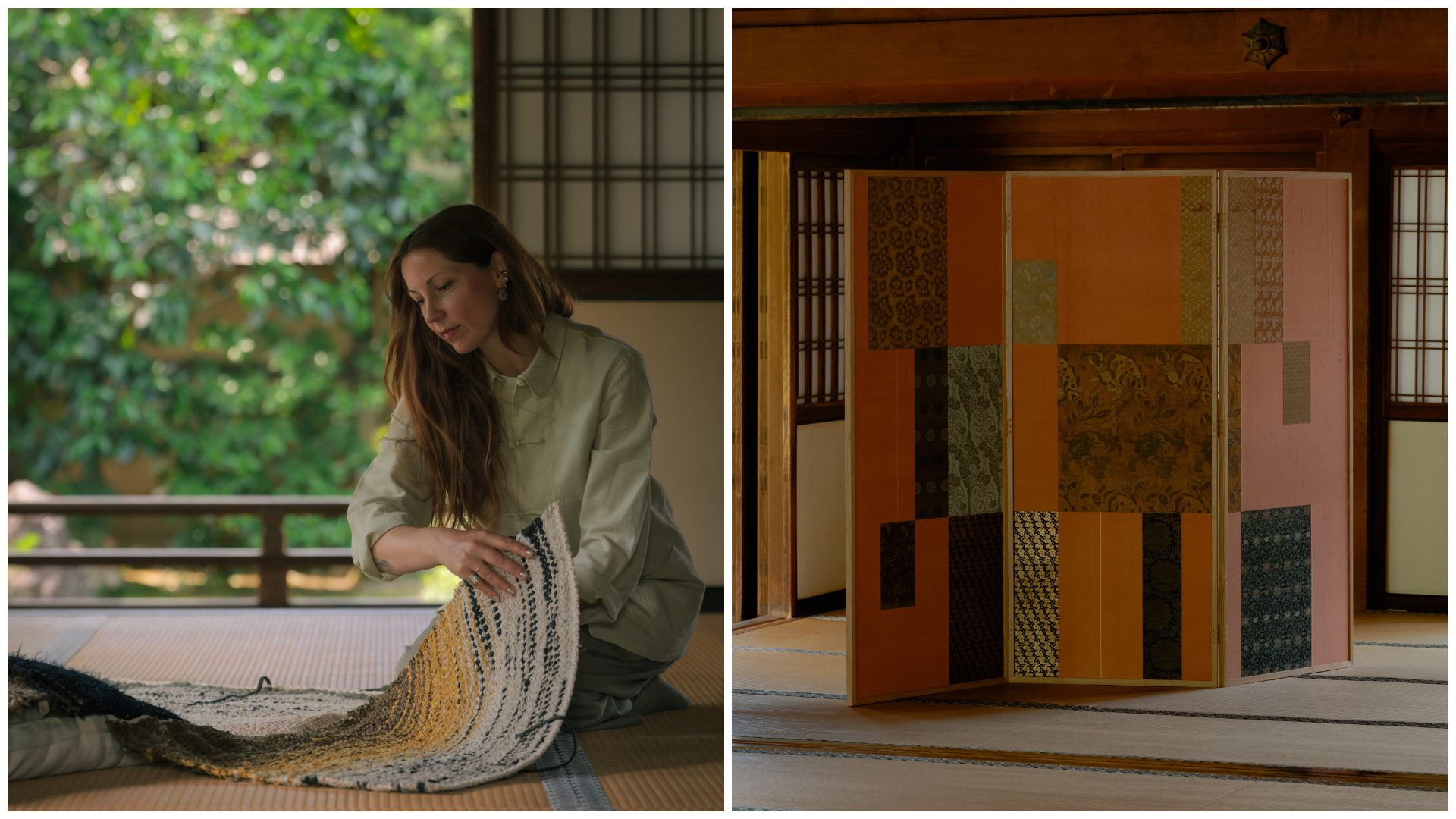
Mae Engelgeer has spent the past decade building a practice from her Amsterdam studio that sits in the disciplinary gap between industrial textile design and fine art. Her commissions include residential interiors, hospitality projects, and product collaborations with firms like Maharam and Kvadrat. None of those prepared her portfolio for what opened this week in Kyoto: a site-specific installation inside Ryosokuin, a 14th-century Zen sub-temple within the Kenninji complex.
The commission places Engelgeer's woven panels and spatial interventions within a structure founded in 1358, roughly a century before the printing press reached the Low Countries. Ryosokuin functions as a working temple, not a museum. Monks practice there. Visitors remove their shoes. The installation, running through 7 July, exists within an active sacred programme rather than adjacent to one.
This is a drift that Dutch design institutions have rarely executed. The Netherlands has a long tradition of exporting commercial craft: Droog, Hella Jongerius, Studio Job. Those exports tend to land in galleries, fairs, and retail contexts where the object remains framed as product or collectible. Engelgeer's Ryosokuin work repositions the discipline. A textile commission inside a functioning temple is not a trade-fair booth in Milan or a vitrine at Stedelijk. It is institutional space of a different order, one where the work must coexist with ritual rather than observation.
The timing matters. Dutch design's international conversation in 2026 has centred on sustainability credentials and circular-economy frameworks, language that circulates well at Salone del Mobile but rarely crosses into sacred or civic commissions outside Europe. Engelgeer's Kyoto residency, which preceded the installation, placed her inside a craft lineage, Japanese textile weaving, that operates on timescales her Amsterdam practice does not typically reference. The resulting work, according to the studio, responds to temple architecture and light conditions specific to Ryosokuin's tatami rooms.
For Amsterdam's design community, the move names a pathway that remains underexplored. The city's institutional infrastructure, Stedelijk, Het Nieuwe Instituut in Rotterdam, the galleries clustered around the Jordaan, tends to circulate Dutch craft within a European museum-and-fair circuit. Engelgeer's temple commission suggests an alternative: positioning Dutch makers within non-European institutional contexts that are neither commercial nor strictly curatorial. The frame shifts from design-as-export to design-as-dialogue.
Ryosokuin is not a major tourist site. It sits within Kenninji, Kyoto's oldest Zen temple, but receives a fraction of the foot traffic that moves through Fushimi Inari or Kinkaku-ji. The audience for Engelgeer's installation will be modest by commercial standards, likely measured in hundreds rather than thousands. That scarcity is part of the point. The commission's value lies less in reach than in category: a Dutch designer, working from Amsterdam, placing textile work inside a space whose institutional authority predates the modern concept of design itself.
The installation closes 7 July. Engelgeer returns to Amsterdam, where her studio continues product work for European clients. Whether the Kyoto commission opens further sacred-space commissions remains unclear. What it has already done is name a drift: Dutch textile practice can occupy ground that the discipline's dominant narratives, sustainability, circularity, commercial craft, have not yet claimed.