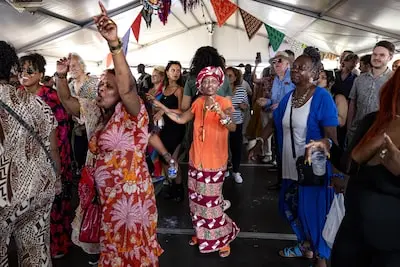
Kwaku Summer Festival will not return after 2026. The organisation confirmed the closure on 23 July, ending a run that began in 1975 when Surinamese migrants in the Bijlmer organised the first informal gatherings in what was then a new housing estate on the edge of Amsterdam. The festival grew into the largest free multicultural event in the Netherlands, drawing tens of thousands across summer weekends to Nelson Mandela Park. Its final edition opens this weekend.
The statement from Stichting Kwaku Festival names affordability and accessibility as the pressure points. Production costs have risen steadily since 2019. The festival has remained free at the gate, but the gap between that commitment and the city's subsidy framework widened each year. Kwaku received municipal funding, but not at a level that offset staging costs for a multi-weekend programme with live music, sport tournaments, and food stalls representing Surinamese, Antillean, Ghanaian, and Nigerian communities.
The preference gap here is structural. Kwaku is cited in every municipal report on Zuidoost's cultural identity. It appears in tourism materials. It is invoked when the city discusses inclusion. Yet the operational subsidy never reached parity with single-weekend events in the centre that draw smaller, whiter crowds. The festival was present everywhere in the city's self-description and chosen rarely when budgets were allocated.

Zuidoost's cultural infrastructure has thinned over the same period. The Bijlmer Parktheater closed for renovation in 2022 and reopened with a reduced programming budget. Several community centres that hosted year-round events adjacent to Kwaku's mission have scaled back. The festival was not an isolated casualty but the most visible one.
The timing is pointed. Amsterdam is hosting WorldPride 2026 this summer, and Kwaku's Roze Zondag, a day dedicated to LGBTQ+ celebration within the festival, has been a fixture since 2005. The festival's final edition will include that programme, but the event that gave Roze Zondag its context will not exist by the time WorldPride concludes.
Forty-nine years is not a round number. The festival did not reach its fiftieth anniversary. That one-year gap will sit in the record as a measure of how close the city came to sustaining something it claimed to value.
The subsidy disparity the Stichting describes is not abstract. A festival that spans multiple weekends, programmes live music across genres, hosts sport tournaments, and maintains food stalls from four distinct diasporic communities requires a production infrastructure that single-day events in the centrum do not. The cost curve bends upward with each additional weekend; the municipal funding line stayed flat. Kwaku's commitment to free entry meant the organisation absorbed that widening margin rather than passing it to attendees, until absorption was no longer possible.
What disappears with Kwaku is not merely a summer programme but the organisational capacity behind it. The Stichting built relationships with Surinamese, Antillean, Ghanaian, and Nigerian communities over nearly five decades. It created a venue where Roze Zondag could exist within a Black cultural context rather than adjacent to it. That connective tissue does not transfer automatically to another institution. The city retains the language of inclusion; it loses the infrastructure that made inclusion legible in Zuidoost.
The Stichting has not announced plans for the organisation's future. The final weekends run through early August in Nelson Mandela Park, free entry, as they have always been.