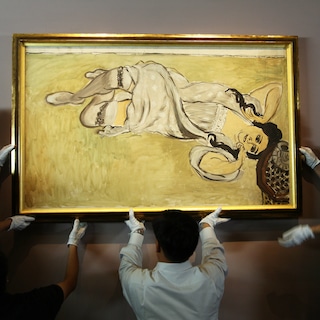
H'art Museum Amsterdam has confirmed it will host a major exhibition of work by Henri Matisse, the French modernist whose market position remains unassailable nearly seventy years after his death. The announcement, reported by Het Parool on 26 May, arrives without confirmed dates but with institutional intent clearly signalled: H'art is staking ground before the centenary programming wave that will define European museum calendars through 2026 and into 2027.
The timing is not accidental. Matisse died in November 1954, placing the seventy-fifth anniversary of his death in late 2029, but the institutional cycle does not wait for round numbers. Centre Pompidou, which holds the largest Matisse collection outside of the Barnes Foundation, has been closed for renovation since 2025 and will reopen with a major retrospective. The Tate, the MoMA, and a half-dozen regional European institutions are all positioning for the same window. H'art's announcement functions as a claim: we are in the conversation before the conversation becomes crowded.
The museum's recent history supports the strategy. Since rebranding from the Hermitage Amsterdam in 2022, following the institutional break with Russia's State Hermitage after the invasion of Ukraine, H'art has rebuilt its programming identity around loans and partnerships that position it as a serious player in the European circuit rather than a satellite venue. The Matisse announcement extends that positioning into the most competitive tier of museum programming: the modernist blockbuster.
What the announcement does not include is as instructive as what it does. No dates, no loan partners, no indication of whether the exhibition will draw from French national collections, American private holdings, or both. The absence suggests negotiations are ongoing, which in turn suggests H'art is competing for works that other institutions also want. The announcement itself becomes a signal to potential lenders: we are committed, we are moving, we are worth your loan.
For Amsterdam's museum landscape, the move represents a structural shift. The Stedelijk, the city's designated modern and contemporary art institution, has not mounted a Matisse-scale modernist retrospective in recent memory, preferring to focus on postwar and contemporary programming that aligns with its collection strengths. H'art is not challenging the Stedelijk's position so much as occupying adjacent territory: the loan-driven, event-driven model that treats the museum as a venue for traveling exhibitions rather than a collection-based institution.
The question is whether Amsterdam can support two institutions competing at that level. The Van Gogh Museum already operates in the blockbuster space, drawing over two million visitors annually to a collection-based model supplemented by major loans. The Rijksmuseum occupies the national-heritage position. H'art's bet is that the market has room for a third institution, one that moves on opportunities the others cannot or will not pursue.
Matisse is the test case. The announcement arrives months, possibly a year or more, before the exhibition itself. That lead time is the point. H'art is not just announcing an exhibition; it is announcing a capability. The institutional calendar will catch up eventually. H'art is making sure it is already there when it does.