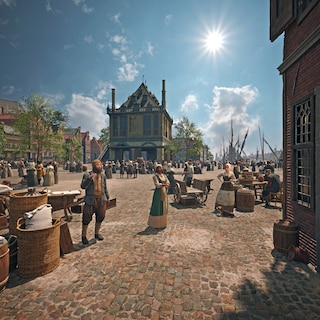
A new institution has opened on the Rokin that refuses the label its technology invites. Entr, a VR museum dedicated to 17th-century Amsterdam, positions itself against the tourist attraction model even as it occupies prime tourist geography. The founders state it plainly: they do not want to be a toeristenattractie. What they want is harder to name, and more interesting for it.
The experience places visitors inside Amsterdam in 1652, not as observers but as workers. You are a walvisvaarder processing blubber on a ship, a printer setting type in a workshop, a craftswoman shaping goods in a market stall. The VR environments are detailed enough to sell the illusion and uncomfortable enough to prevent the detachment that plagues most heritage media. The work is repetitive. The spaces are cramped. The simulation does not romanticise.
This represents a drift in how Amsterdam institutions approach the Golden Age. The Rijksmuseum presents the period through painting and object, the Amsterdam Museum through narrative and artefact, the canal houses through preserved interiors. Each format keeps the visitor at a distance, looking at the past rather than inhabiting it. Entr collapses that distance, then makes the collapse feel like labour rather than spectacle.
The choice of 1652 is precise. The year falls in the middle of the First Anglo-Dutch War, a period of intense maritime activity and economic strain that rarely appears in popular accounts of the Golden Age. The VOC was ascendant but not yet dominant, the city was wealthy but not yet the world's financial centre, and the working conditions that produced that wealth were still visible on every street. Entr's simulation foregrounds those conditions without moralising about them.
The technology itself is secondary to the design philosophy. VR museums have existed for years, most of them offering passive tours through reconstructed spaces. Entr's innovation is interactivity directed toward task completion rather than exploration. You do not wander through 1652 Amsterdam; you work inside it. The sessions are timed. The tasks are scored. The experience has more in common with workplace simulation than museum education.
The founders' rejection of the toeristenattractie label is strategic as well as philosophical. Amsterdam's tourism economy has made attractions out of everything from cheese shops to coffeehouses, and the city government has spent years trying to disperse visitor traffic away from the centre. A VR museum on the Rokin that explicitly distances itself from tourist culture is making a claim about its audience: locals and serious visitors, not cruise-ship passengers with 90 minutes to spend.
Whether that claim holds will depend on pricing and word-of-mouth. Entr has not disclosed ticket costs, but the technology requirements suggest a premium above traditional museum entry. The question is whether the experience justifies repeat visits or functions as a one-time novelty. The founders' language suggests they are building for return traffic, an audience that treats the simulation as a skill to develop rather than a box to check.
The institution's relationship to the Amsterdam Museum is worth noting. That museum has spent years repositioning itself away from Golden Age triumphalism toward a more critical account of the city's history. Entr operates in parallel: it does not critique the period so much as embody its textures, letting visitors draw their own conclusions from simulated experience rather than curatorial framing. The drift here is methodological. Heritage becomes something you do, not something you view.
Amsterdam has long monetised its past. Entr proposes a different transaction: pay to work in history, and see whether the work changes how you understand it.