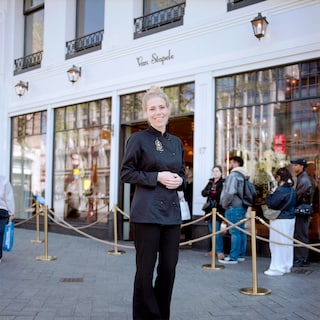
When Vera van Stapele opened her cookie shop on Heisteeg in 2013, the proposition was simple: one product, one location, a line out the door. Thirteen years later that line remains the most reliable piece of street theatre in the Negen Straatjes, a daily confirmation that scarcity and ritual can build a brand without a single billboard. What the queue obscured was the family building around it.
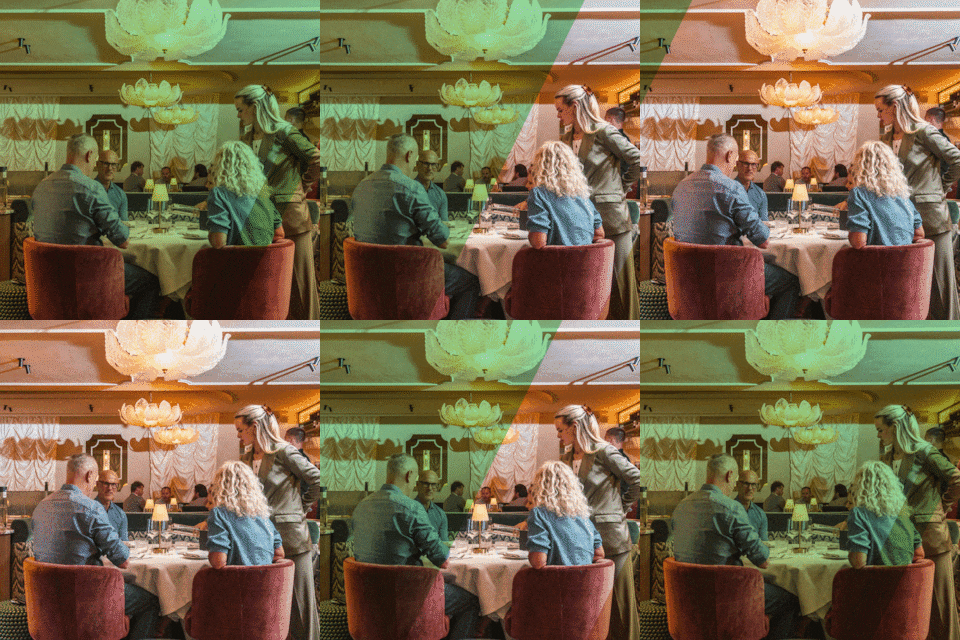
This week Matthijs van Stapele, Vera's brother, opens Chez Chloé, a bistro in Amsterdam-West. Het Parool reports that the room's centrepiece is a custom wine cabinet, not a cookie display. The menu leans French. The proposition is dwell time, not takeaway. On paper this is a restaurant opening. In practice it is the moment a single-product cult brand becomes a hospitality group.
The Van Stapele operation has been drifting toward this for years without announcing it. The cookie shop runs a de facto demand-management system: limited batches, no pre-orders, a queue that functions as its own marketing. That is hospitality logic dressed as retail. Chez Chloé inverts the terms. Where Heisteeg is about compression, the bistro is about expansion: wine pairings, seated service, evening hours. The family is now operating on both ends of the hospitality spectrum, fast and slow, with the same surname on the awning.
The drift matters because of what it signals about Amsterdam's independent food economy. A decade ago the path from cult product to growth meant wholesale, airport concessions, maybe a second location in Rotterdam. The Van Stapeles skipped that playbook. They kept the cookie shop singular and built outward into adjacent categories instead. A bistro is harder to scale than a second bakery, but it is also harder to commodify. The wine cabinet cannot be copied by a chain.
Matthijs tells Het Parool that the wine selection is the room's identity. That framing is deliberate. Wine hospitality in Amsterdam has become a crowded field, from neighbourhood natural-wine bars to hotel sommeliers competing for the same allocated bottles. A bistro anchored by a cabinet rather than a kitchen positions Chez Chloé as a drinking destination that happens to serve food, not the reverse. It is a bet on connoisseurship over convenience.
The family's Instagram following, built on cookie content, will not transfer automatically. A photo of a warm cookie splits cleanly on a feed. A wine list does not. Chez Chloé will need its own audience, and that audience will likely be older, more local, less interested in queuing. The Van Stapeles are trading tourist traffic for neighbourhood regulars, a swap that changes the unit economics entirely.
None of this is accidental. The cookie shop taught the family how to manage demand, read a room, and say no. Chez Chloé is where they apply those lessons to a format that requires the opposite skill: saying yes, stay longer, order another glass. The drift from bakery to bistro is also a drift from scarcity to hospitality, and the two are harder to run in parallel than they look.