The arithmetic of Amsterdam's brown café has quietly inverted. A portion of bitterballen, the deep-fried ragout balls that have sat on every café menu since the category existed, now costs €9 to €12 at addresses across the canal ring and beyond. A standard pilsner at the same establishments runs €3.50 to €4.50. The snack costs more than the drink it was designed to accompany.
Het Parool's survey of café operators this week surfaces a consistent line: the price has climbed, and the orders have not dropped. 'They always sell,' one operator told the paper. The statement carries more data than it appears to. It confirms that the café sector has tested the ceiling repeatedly, found no resistance, and continued to push.
The operational logic is defensible on paper. Labour costs in Amsterdam hospitality have risen sharply since 2021. Energy bills spiked and never fully retreated. Frying oil, beef, and breadcrumbs all track commodity indices that have outpaced general CPI. A café that held bitterballen at €6 in 2021 while absorbing cost increases would now be subsidising the snack with margin from elsewhere on the menu.
But the speed of the shift has outrun any public reckoning with what it means. The brown café, as a cultural institution, was built on the premise of democratic access: a place where a student, a pensioner, and a canal-house owner could occupy adjacent stools and order from the same menu without class friction. The bitterballen price was never the point. It was the proof. A snack that cost the same for everyone signalled that the room belonged to everyone.
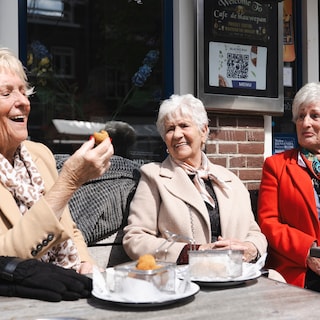
That signal has changed. A portion at €11 is no longer a casual add-on to a round of drinks. It is a deliberate hospitality expenditure, one that prices out the customer segment for whom the brown café was historically the only affordable option. The pensioner on AOW calculates differently than the consultant expensing the evening.
The Parool piece does not name this as a structural shift, and the operators quoted do not frame it that way either. They speak in cost-recovery terms, in margins and ingredient bills. The framing is operational. But the outcome is demographic. The price has moved faster than the public understanding of what the brown café is for.
This is where the lag sits. The price is a 2026 price. The expectation, for anyone who has not visited in two years, remains a 2019 expectation. The cultural narrative of the accessible neighbourhood café persists in tourism copy, in lifestyle guides, in the self-image of the city. The menu has already moved on.
What the operators have discovered, and what the steady demand confirms, is that the customer base has shifted too. The addresses that can charge €12 for bitterballen and see no drop in orders are not serving the same clientele they served a decade ago. They are serving a room that can absorb the price, which means they are serving a different room.
The question the data does not answer is whether the previous room still exists somewhere else, or whether it has simply stopped going out.