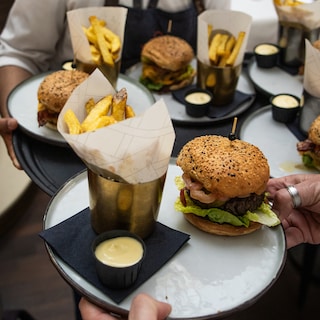
The premise is simple enough: four friends, meeting regularly over twelve years, order a hamburger at each venue. They rate it. They move on. What accumulates is a dataset that spans institutional categories Amsterdam hospitality prefers to keep separate: the five-star hotel dining room, the bruine kroeg with linoleum floors, the unmarked restaurant the group describes, in Het Parool's telling, as 'louche.' The verdict, articulated this week as the project reaches its hundredth entry, lands precisely where the hospitality industry does not want it: 'Hoe minder fratsen, hoe beter.'
The phrase translates loosely as 'the fewer flourishes, the better,' and it functions as an indictment of a particular Amsterdam hospitality mode. The five-star hotel burger, in this reading, suffers from exactly the additions its price point demands. The truffle aioli, the artisanal bun, the wagyu patty flown in from a prefecture the server can name: these are not improvements. They are justifications for a room rate that has nothing to do with the kitchen.
What makes the project analytically useful is the duration. Twelve years is long enough to watch Amsterdam's hospitality sector cycle through several positioning eras. The group began testing in 2014, which places their early entries in the pre-Instagram moment when hotel food-and-beverage was still understood as a loss leader, a service amenity rather than a brand statement. By 2018, the sector had pivoted: hotel restaurants were meant to pull non-guests, to function as standalone destinations. The burger, in this model, became a vehicle for demonstrating culinary seriousness, which meant adding components.
The bruine kroeg operates under no such pressure. The burger is a burger. It arrives with fries. The patty is beef, seasoned, cooked on a flat-top. The pricing reflects the cost of goods and labor, not the cost of maintaining a lobby. This is the preference gap the project names without using the term: the venues where Amsterdam actually eats (the kroeg, the unmarked corner spot) are not the venues Amsterdam promotes (the hotel, the chef-driven concept). Presence and choice diverge.
The data also captures a structural feature of Amsterdam hospitality the project's authors may not have intended to document. The 'louche' category, included almost as a joke, turns out to produce consistent results. These are venues operating outside the formal review economy, unmarked or poorly reviewed on Google, surviving on neighborhood regulars and word-of-mouth. They have no incentive to add flourishes because they have no audience that would reward them. The burger is calibrated to the room, and the room is calibrated to function rather than positioning.
What the project does not address, and what would require a different kind of study, is whether the gap is closing. The past three years have seen a visible drift in Amsterdam hotel food-and-beverage toward simpler menus, shorter ingredient lists, and less architectural plating. The Conservatorium's pivot toward Ottolenghi, which we covered earlier this year, is one instance of a larger pattern: five-star kitchens borrowing the language of the neighborhood spot. Whether this represents a genuine operational shift or a new form of flourish, the hundred-burger dataset cannot say. But it can say what twelve years of eating in Amsterdam taught four friends: the room that charges the most often delivers the least.
The project concludes, at least in its current form, this month. Whether the group continues, or whether the dataset becomes the basis for something more formal, remains unclear. What is clear is that amateur longitudinal studies of this kind capture something the professional review economy cannot: a record of what happens when the same palate returns to the same question, in the same city, across enough time to watch the sector change. The answer, in Amsterdam, is that the sector changed in the wrong direction, and is only now beginning to correct.