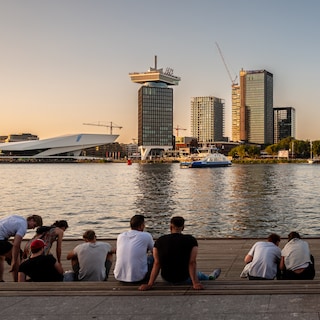
When the A'dam Toren opened in May 2016, the pitch was creative economy. The former Shell headquarters would become a vertical village for music, media, and nightlife. The rooftop would host a club. The offices would fill with startups and studios. The building would anchor Noord's transformation from post-industrial periphery to something resembling a scene.
Ten years later, the building has delivered on some of that promise. It has also drifted into a function its original positioning did not name: tourist infrastructure. The swings, branded Over the Edge, have become one of the most photographed attractions in the city. The Lookout observation deck processes queues of visitors who will never enter the offices below. The hospitality floors, Madam and Moon, cater increasingly to visitors rather than locals. The building works, but it works as something different than what was sold.
This drift is not unique to the A'dam Toren. Amsterdam's post-2010 development cycle produced a series of buildings pitched as creative economy anchors that have since evolved into tourism-adjacent functions. The Westergasfabriek, De Hallen, NDSM: each was positioned as a platform for local creative production. Each has, to varying degrees, shifted toward serving the visitor economy. The A'dam Toren is simply the most vertical expression of the pattern.
The question is whether this drift represents failure or adaptation. From a commercial perspective, the building is successful. Occupancy rates are high. The rooftop attractions generate consistent revenue. The ferry connection to Centraal Station delivers a steady flow of foot traffic. The operators have built a viable business.
From a cultural perspective, the picture is more complicated. The original programming suggested that the A'dam Toren would be a place where Amsterdam's creative industries clustered. Some of that has happened. But the dominant use case, the function that defines the building's public identity, is the observation deck and the swings. The A'dam Toren is, first and foremost, a place where tourists go to look at Amsterdam and photograph themselves doing it.
This is not a criticism of the operators. They responded to demand. The swings exist because people want to ride them. The Lookout exists because people want the view. The building has become what the market wanted it to become, which is not quite what the developers said it would become when they were seeking approval and financing.
The anniversary coverage, including Het Parool's feature this week, treats the building's integration into Amsterdam's identity as a success. The swings, the piece notes, now feel like they belong to the city. This is probably true. It is also a description of how tourist infrastructure becomes normalised. First it is novel, then it is popular, then it is described as essential. The A'dam Toren has completed that arc.
What remains unclear is what this means for Noord's next decade. The neighbourhood around the tower has continued to develop, but the creative economy thesis remains partially unfulfilled. The large institutions, Eye Filmmuseum, the Tolhuistuin, have held their positions. The smaller operators, the galleries and studios and DIY venues that were supposed to fill the middle ground, have not materialised at scale. The A'dam Toren attracts visitors. Whether it anchors a scene is a different question.
At ten years, the building is stable. It is also a useful case study in how development narratives and operational realities diverge over time. The A'dam Toren was pitched as a creative hub. It became a tourist attraction. Both things can be true, but they are not the same thing, and the gap between them is worth naming.