Six months. That is the gap between Victoria's Secret closing its Lippo Plaza flagship on Shanghai's Huaihai Road, on an expired lease, and opening a new flagship three blocks away at Longfeng PRSCO. Same street. Same city. A different retail format inside.
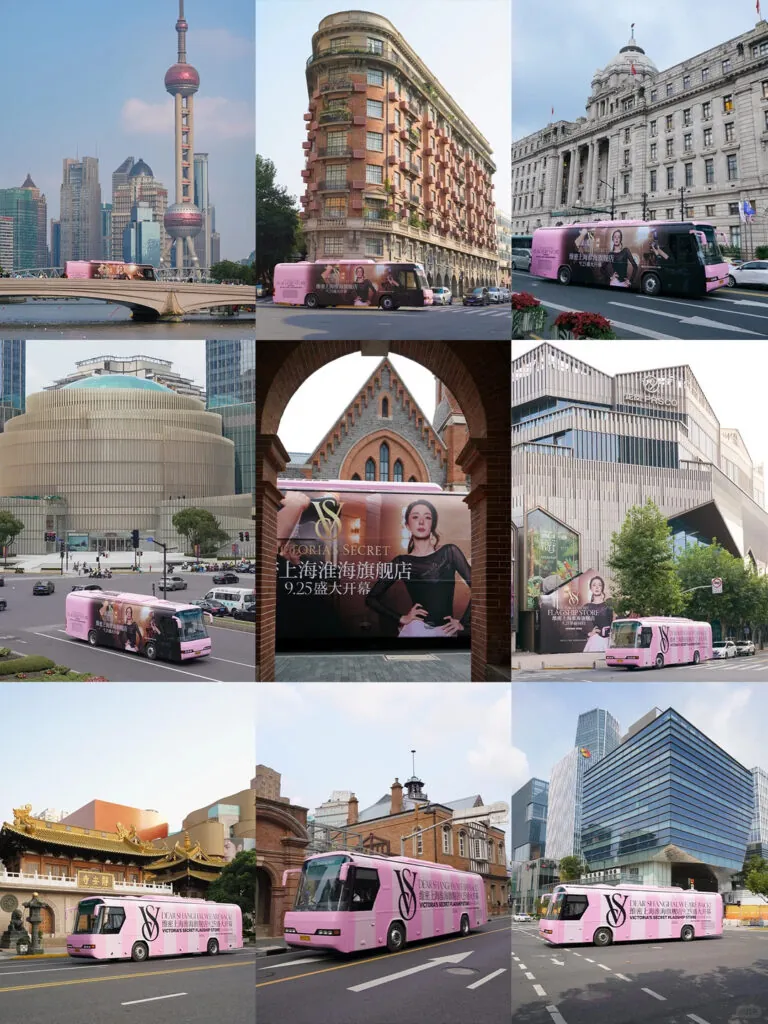
The old store ran on the format Victoria's Secret exported to China a decade ago: a pink-saturated, lingerie-forward box built around the brand's signature colors and its signature silhouette of femininity. The new flagship, according to reporting on the brand's China strategy shift, adjusts what the store is expected to deliver. The brand's own retail language has moved from pure apparel merchandising toward something closer to lifestyle retail, the kind of store that sells a mood as much as a product line.
Victoria's Secret has treated China as a growth market since 2017. Nine years in, the operational record shows one flagship closure and one flagship reopening on the same street inside a single calendar year. That is not an expansion story. That is a retreat followed immediately by a hedge: close the underperforming format, reopen a revised one at the same address before competitors or landlords claim the real estate.
The brand has also leaned on collaboration to re-enter the conversation in China, pairing with Luckin Coffee ahead of a tour stop and working with a Chinese designer on past capsule drops. Those moves sit outside the store itself. The flagship reopening is the store format admitting what the collaborations already implied: the old Victoria's Secret playbook, pink boxes selling a single silhouette, was not converting in this market at the rate the brand needed.
The sequence matters more than either event alone. A closure by itself could mean simple contraction, a landlord dispute, or a lease that ran out without a renewal worth signing. A reopening by itself could mean nothing more than relocation within the same district. Together, on the same street, inside one calendar year, the two events describe a brand deciding the address was worth keeping and the format was not. Huaihai Road was not the problem. The pink box was.
That distinction explains why the collaborations with Luckin Coffee and the Chinese designer capsule read as preparation rather than noise. Neither moved product through a Victoria's Secret store. Both moved the brand name through channels the old flagship format never touched: a coffee chain's customer base and a designer's following. The flagship reopening is where that groundwork gets tested against an actual retail floor, in the actual city, on the actual street where the prior format already failed to convert at the rate the brand needed.
Nine years of treating China as a growth market produced, on this block, one closure and one hedge. The lifestyle-retail format now has the address, the timing, and the preceding collaborations working in its favor. What it does not have yet is a second data point of its own.
Huaihai Road now carries two data points six months apart: one closed Victoria's Secret, one reopened Victoria's Secret, same city block, different store inside. The second data point is the correction. 5 October 2026 is the date the correction went live.