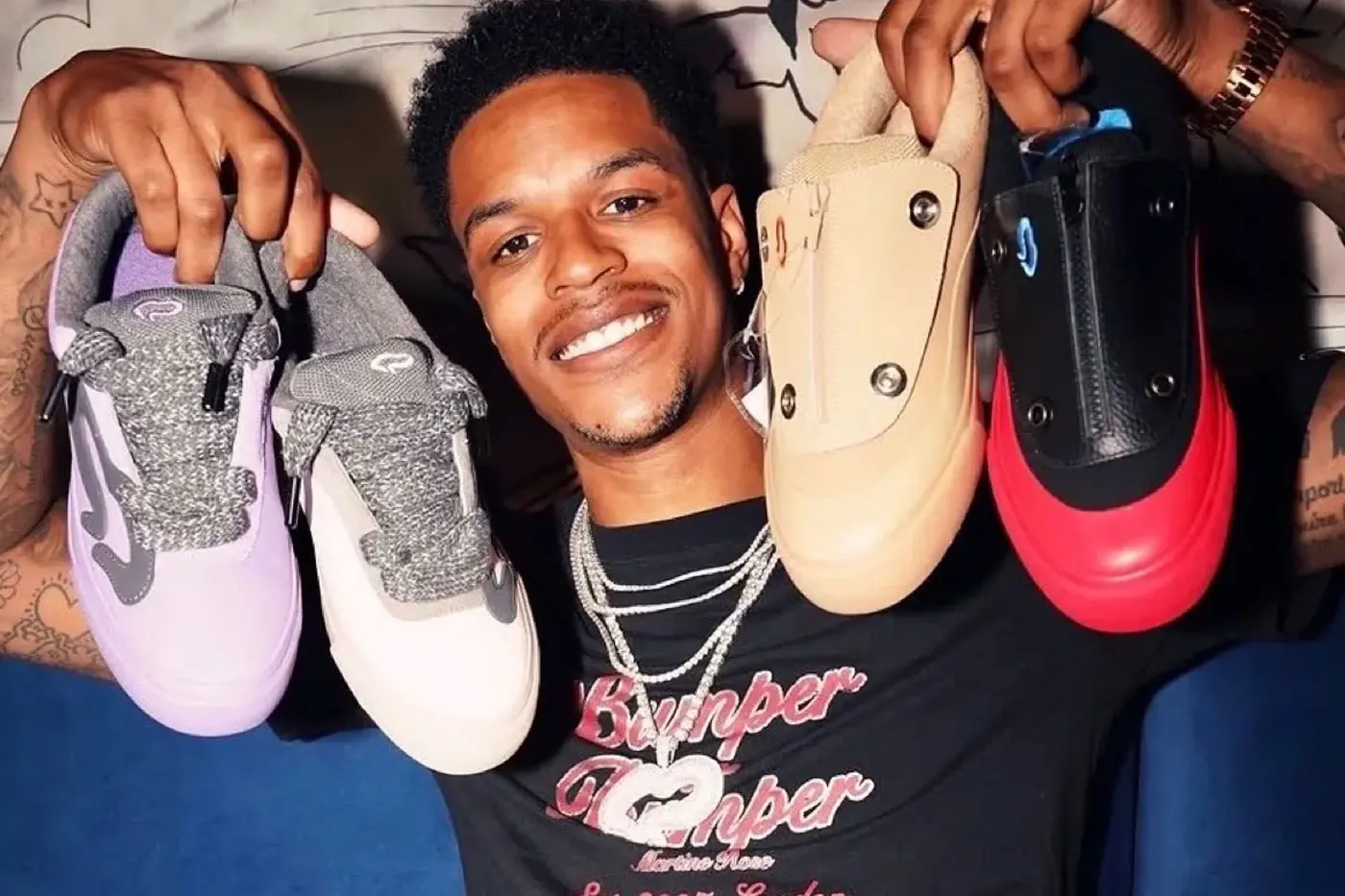
An unnamed lifestyle silhouette sits next to the Devastator 4XT on a preview table at New York Fashion Week, and neither one looks like it was built for a seven-footer. That is the whole story here: Shaquille O'Neal's footwear label, built for two decades on a big man's proportions and a big man's name recognition, is being handed to his son Shareef, and the handoff comes with a running-style model that reads like it belongs to an entirely different customer.
This is a family business succession playing out in real time on a fashion week showroom floor, which is its own category now, distinct from both the athlete-signature sneaker and the celebrity-fronted streetwear label. Shaq Brand has spent years selling affordability and scale, big-and-tall sizing as a market position rather than an afterthought. Shareef by Shaq does not appear to be extending that position. It is opening a second lane inside the same house, aimed at a younger, more fashion-literate buyer who was likely in middle school when Shaq's last signature shoe dropped.
What makes this a fashion week story rather than a footwear trade story is the venue choice itself. Sneaker previews from athlete-adjacent brands typically happen at trade shows or brand activations timed to a sports calendar. Placing the debut inside New York Fashion Week signals that Shareef by Shaq wants to be read against the runway, not against the sneaker wall at a big-box retailer, even though no release dates or pricing have been announced yet. The absence of hard commercial detail, at a moment when most footwear previews arrive with at least a release window, suggests the show was built to establish an identity before it establishes a shelf price.
The showroom pairing matters more than any single design choice. Setting an unnamed lifestyle silhouette next to the Devastator 4XT was not an accident of table space, it was a thesis statement: the old shoe stands for the old customer, the new shoe stands for someone else entirely. That kind of side-by-side is usually reserved for brands trying to prove continuity. Here it seems to be doing the opposite, proving distance.
The lack of release dates or pricing reads differently once the venue is factored in. A trade show debut without commercial detail looks unfinished. A fashion week debut without commercial detail looks intentional, a way of asking the audience to judge silhouette and proportion before judging accessibility or cost. Shaq Brand's whole affordability position was built on big-and-tall sizing as a stated market strategy, so a launch that withholds price signals a brand that wants to be evaluated on different terms than the one it is emerging from.
That leaves Shareef by Shaq carrying two audiences at once, the customer who remembers what Shaq Brand stood for and the younger, fashion-literate buyer the new silhouettes seem built for. Fashion week can introduce a name, but it cannot resolve which of those audiences the brand is actually for. That resolution will come from the shoe wall, not the runway.
Shaq built a brand on volume and a very specific body type. Shareef by Shaq is now a lineage brand, the kind that has to answer for its name before it answers for its product, and that puts it in the same category as any founder-to-heir fashion transition: the son's designs will be read first against the father's legacy, and only second against the shoe itself.