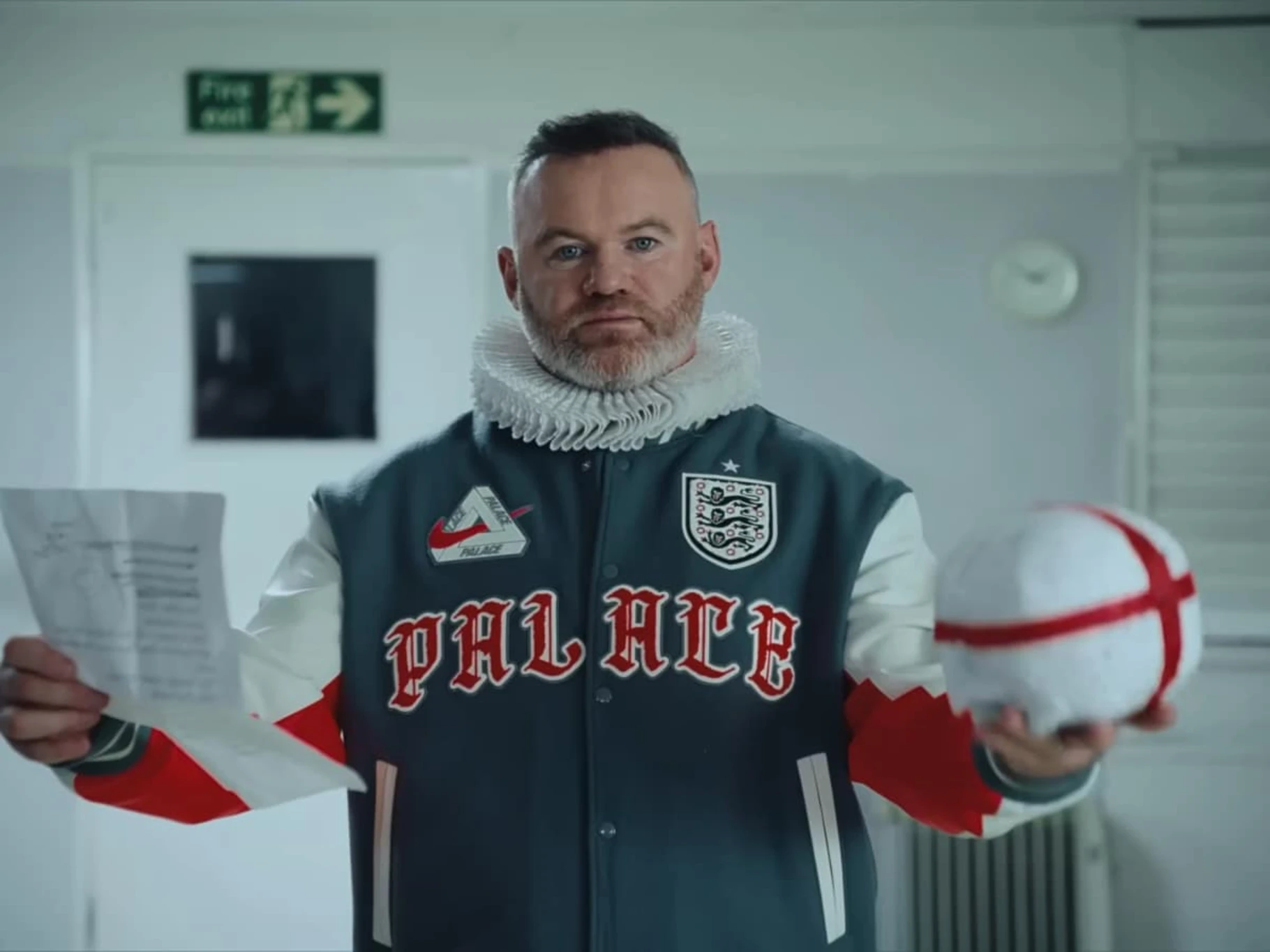
The video opens with Wayne Rooney, 40 years old, speaking lines from Shakespeare. Not stadium commentary, not punditry, not a training montage. The retired England striker recites verse while the camera cuts between contemporary London supporters and reconstructed scenes that travel backward through English football history, arriving eventually at Neolithic figures kicking something round across open land. The Palace x Nike England World Cup campaign film, released today, runs just under three minutes and makes no attempt to sell product until the final seconds.
The collaboration itself is not new. Palace and Nike have been circling each other since the South London skate label opened Manor Place, its cultural hub in Elephant and Castle, with Nike as a founding partner. That space functions as retail, event venue, and community centre. The Nike partnership has delivered footwear, apparel, and now, with the 2026 World Cup weeks away, a full England kit collection. But the campaign film marks a shift in register. This is not product photography with athlete endorsements. This is Palace commissioning a short film that treats English football as anthropology.

Jill Scott appears alongside Rooney, representing the women's game. The cast expands to include hundreds of supporters filmed across multiple locations, none of them professional actors. The production ambition is visible: period costumes, practical effects, location shoots that required coordinating crowds. Palace has made campaign films before, but they tend toward lo-fi humor, skate footage, and inside jokes. This is something else entirely.
The pattern is worth naming. Palace began as a London skate crew with a logo, a sense of humor, and a talent for scarcity marketing. Its collaborations in the early years leaned on irony and subcultural capital: Reebok Classics, Adidas tracksuits, the Juventus football shirt that sold out in minutes. The Nike partnership, which formalised around 2022, moved the label into different territory. Manor Place required institutional thinking. The England campaign requires historical thinking. Palace is now in the business of producing cultural narrative at national scale.
Nike's own position has shifted. The brand's football presence in England has historically run through individual athlete endorsements and club partnerships. This campaign treats the national team as a cultural property to be interpreted rather than simply sponsored. The choice to cast Rooney, who has not played for England since 2018, signals that the target is not current performance but accumulated meaning. Rooney's value here is not as a pitchman but as a figure who carries memory.
The collection drop date has not been announced. The film functions as a standalone cultural object, released before consumers can purchase anything from it. That sequencing is deliberate. Palace has learned that anticipation sells better than availability. The film will circulate, accumulate views, generate conversation. The product will arrive later, into a market already primed.
What is happening is category drift. A skateboard brand is producing heritage content for a national football team. A sportswear company is commissioning arts programming. A retired striker is performing Shakespeare. None of these moves are impossible, but the combination signals that the boundaries between streetwear, sport, and cultural production have become porous in ways that are accelerating. Palace is no longer a skate brand that collaborates. It is a production company that skates.