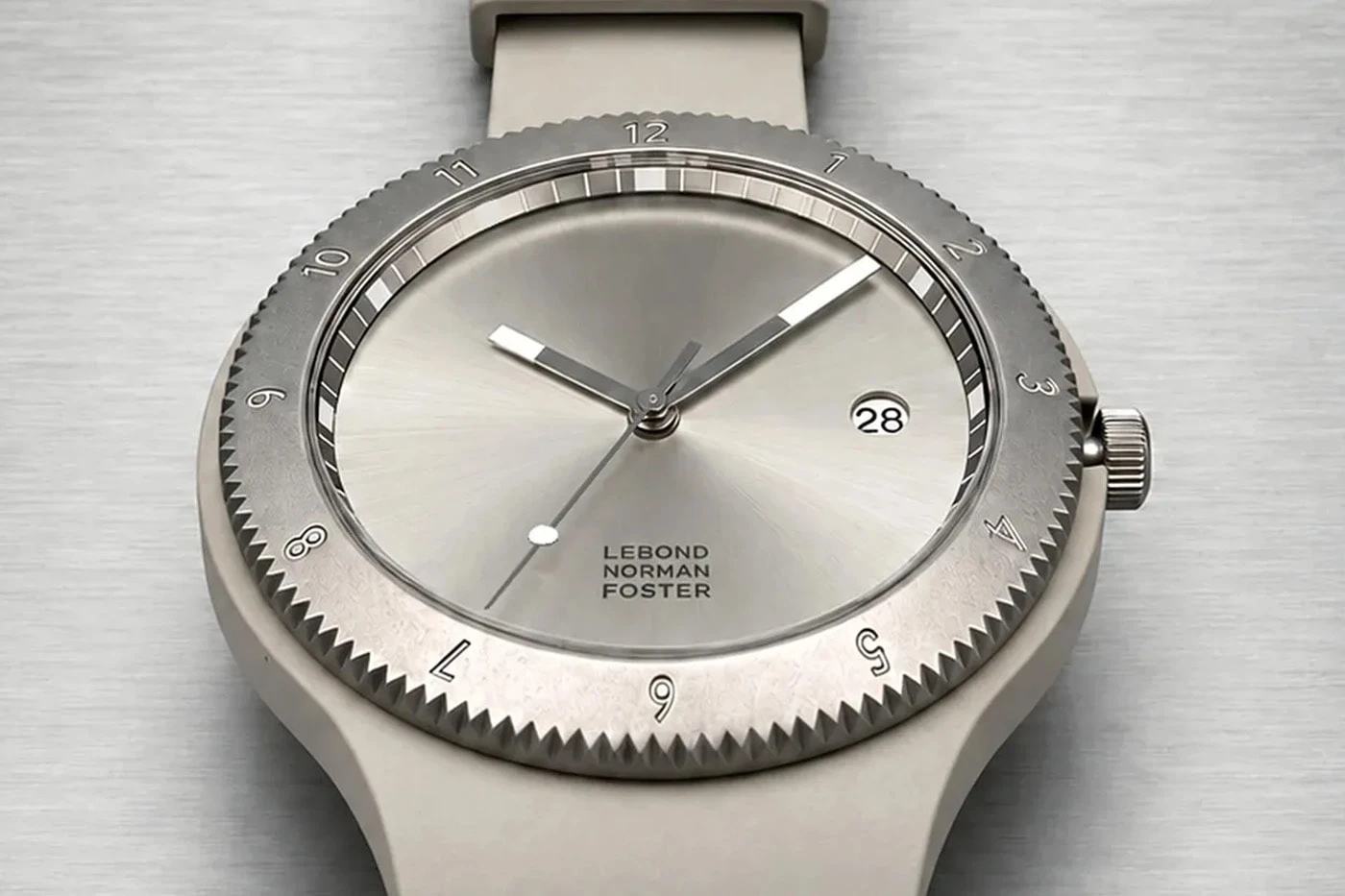
The case is 38.5mm, titanium, with an integrated strap and a 12-hour bezel built for tracking a second time zone. There is nothing showy about it. The two finishes, natural titanium and black DLC, both run on an ETA 2892-A2 automatic movement, the same reliable workhorse caliber that sits inside watches a fraction of the price and several multiples above it. This is a design object stripped to proportion and function, which is exactly the vocabulary Norman Foster has used to describe buildings for fifty years.
What makes the project worth stopping on is not the watch itself but who made it and who did not. Foster is 91 and has never designed a watch before. His studio has shaped the Gherkin, Beijing Capital Airport, Apple Park, the dome over the Reichstag: structures measured in hundreds of thousands of square meters and decades of planning cycles. Lebond, the brand he chose for this first attempt at horology, is an independent microbrand that most watch collectors outside the enthusiast forums would not recognize by name. The partnership did not route through Foster's architecture practice directly either; it ran through the Norman Foster Foundation's Design and Innovation Unit, the nonprofit research arm, rather than a commercial licensing deal with an established maison.
This is a familiar move in architecture, where starchitects regularly license their name to furniture, tableware, or lighting as a kind of retirement-adjacent victory lap, almost always through a recognizable luxury house looking for a credibility injection. Foster inverted the usual direction of prestige. A designer operating at the scale of national infrastructure handed his first attempt at a 38.5mm object to a four-year-old brand with no retail footprint to speak of, rather than to Omega or Jaeger-LeCoultre, either of which would have taken the call.
The watch press will likely frame this as validation for Lebond, a small brand punching above its weight by landing a legend. The more interesting read runs the other way. Foster did not need the scale or distribution of an established maison to make the object correctly; he needed a partner willing to build to his proportions rather than their own house codes. Independent microbrands have spent the last decade positioning themselves as the place where unconventional watchmaking happens because the majors will not take the risk. Foster's choice confirms that the positioning is working on people who have the furthest to fall if it does not.
A watch is architecture's smallest unit of discipline: proportion, mechanism, surface, nothing to hide behind. Foster chose to make his first one with a brand still proving it belongs in the room, and that choice now belongs to the category of design object, independent horology edition.