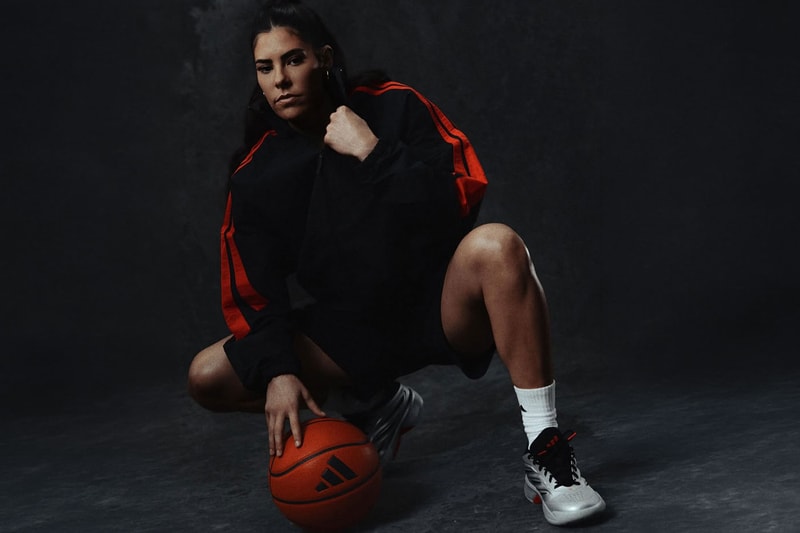
Kelsey Plum is now an adidas athlete. The brand confirmed the signing this week, adding the WNBA champion and Olympic gold medalist to a women's basketball roster that has been quietly accumulating names since 2024. No signature shoe announcement accompanied the news. No product timeline was disclosed. The press release led with the campaign she already shot alongside Anthony Edwards, as if the signing were a formality catching up to work already in progress.

That sequencing matters. Plum left Under Armour without a public farewell, no thank-you post, no mutual-appreciation statement. The gap between her last Under Armour appearance and her first adidas campaign was filled with silence. Industry observers noted she was unsigned; the brand did not comment. Then the Edwards spot surfaced, and the contract followed. The order suggests adidas moved first on content, locking creative before locking paper.
The pattern is familiar. Earlier this year, New Balance signed Cameron Brink to a signature deal before her rookie season concluded, treating WNBA players as franchise-building assets rather than secondary endorsers. Adidas is now operating on a similar logic, but with a different tactic: it is assembling a roster rather than betting on a single name. Plum joins a women's basketball division that has been expanding without flagship announcements, adding players across tiers without the press-cycle theatrics that accompany men's signings.
The economics of women's basketball sponsorship have shifted. WNBA viewership reached record numbers in 2024 and 2025, driven partly by the Caitlin Clark effect but also by a broader audience migration toward women's sports. Brands that treated women's basketball as a corporate-responsibility line item are now treating it as a growth category. The difference is visible in contract structure: signature deals, campaign placements, product development cycles that match the men's side.
Adidas has historically lagged Nike in basketball, losing market share in the men's category through the 2010s before stabilizing with the Harden and Lillard lines. The women's category offers a different calculus. Nike has Sabrina Ionescu and a signature shoe. New Balance has Brink. Puma has been active but unfocused. Adidas is not competing for the single biggest name; it is building depth, signing athletes who can carry regional markets and demographic segments that a single star cannot reach alone.
Plum's value is specific. She is a volume scorer in a league that has historically undervalued volume scorers. She has an Olympic medal. She has crossover visibility from her time at Washington, where she set the NCAA scoring record before the Caitlin Clark era rewrote the conversation. Her audience skews slightly older than the college-to-pro pipeline stars, which gives adidas access to a demographic that is not already claimed by the Clark or Reese cycles.
The Under Armour departure remains unexplained. Plum was a visible part of that brand's basketball push, appearing in campaigns alongside Stephen Curry. Under Armour's basketball division has been contracting since 2023, and the brand has not signed a major women's basketball player since. Whether Plum left or was released, the result is the same: she is now at a brand that is spending in the category while her former sponsor retreats.
Adidas has not announced a signature shoe. The absence is notable. Signature deals are the marker of franchise investment in basketball; endorsement deals without product lines are often short-term visibility plays. The Edwards campaign placement suggests adidas sees Plum as a campaign face, not a product anchor, at least for now. That could change. The brand has historically moved slowly on women's signature products, and the Plum signing may be the first step in a longer rollout.
For now, the signing reads as roster construction. Adidas is not trying to win women's basketball with a single name. It is building a bench, adding players across positions and markets, treating the category as a long-term investment rather than a one-off campaign. Plum is the latest addition. She is unlikely to be the last.