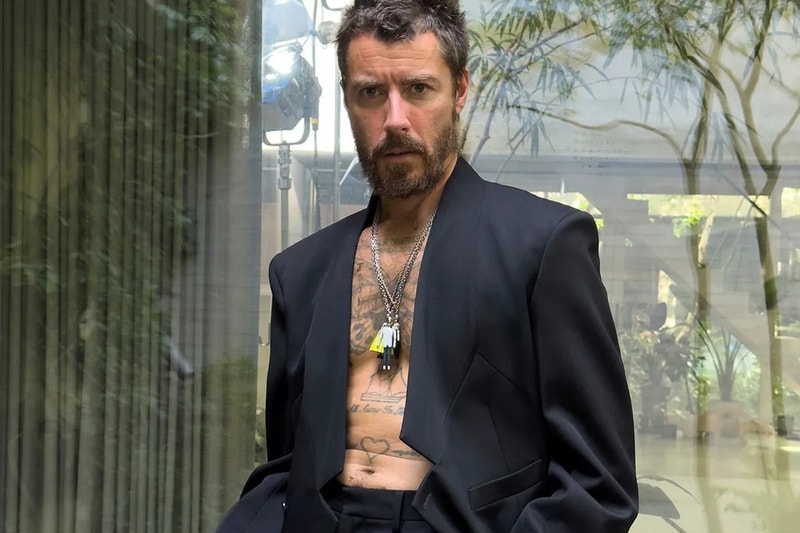
Luxury fashion campaigns operate on a stable premise: the garments are the subject, the faces are the delivery mechanism. A model's job is to disappear into the clothes. Sarah Burton's first Givenchy Men's campaign, shot by Juergen Teller ahead of the SS27 Paris presentation, inverts that logic entirely. The faces are Sir Don McCullin, the 91-year-old British war photographer whose career spans Vietnam, Biafra, and Northern Ireland; Don Letts, the filmmaker and DJ who documented punk's first wave from inside the movement; and Danny Fox, the Cornish painter whose figurative work hangs in private collections on both sides of the Atlantic. None of them model professionally. All of them selected their own garments from the collection.


The contradiction is structural, not stylistic. Givenchy has spent decades building a brand architecture around aspiration: the campaign subject is younger, taller, and more symmetrical than the customer, and the customer pays for proximity to that image. Burton's casting flips the equation. The subjects are older, shorter, and more weathered than the median Givenchy buyer, and the clothes exist to frame their biographies rather than to sell a fantasy. The aspirational object is no longer the garment. It is the life that would allow you to choose your own clothes from a luxury house's offering and wear them as if they were already yours.
This is not the first time a luxury house has cast cultural figures over professional models. Céline under Phoebe Philo ran Joan Didion in 2015. Bottega Veneta under Daniel Lee shot A$AP Rocky and Skepta together in 2019. But those campaigns still treated the subject as a surface for the product. The Burton and Teller approach treats the subject as the primary text and the product as a supporting detail. In the images, Teller's signature lo-fi grain and domestic settings push the garments into the background. What remains is a face, a posture, a set of hands that have held cameras, turntables, and brushes for longer than most Givenchy customers have been alive.
The operational logic has commercial implications. A campaign built around McCullin, Letts, and Fox cannot be refreshed with new talent next season without breaking the premise. The narrative continuity depends on subjects who resist replacement. That creates a tension with the seasonal churn that drives luxury revenue. Burton is betting that the audience she wants to build at Givenchy values coherence over novelty, even though the business model underneath her depends on the opposite.
The timing is worth noting. Burton joined Givenchy in late 2024 after spending her entire career at Alexander McQueen, where she held the creative director title for thirteen years following the founder's death in 2010. Her first Givenchy womenswear collection debuted in March 2025 to reviews that praised restraint over spectacle. The men's campaign extends that register: less noise, fewer professional faces, smaller gestures. Whether the market follows the critics remains an open question. What is clear is that Burton is building a Givenchy that treats authenticity as a luxury good, which is itself a contradiction the house will have to sustain across balance sheets that still require growth.