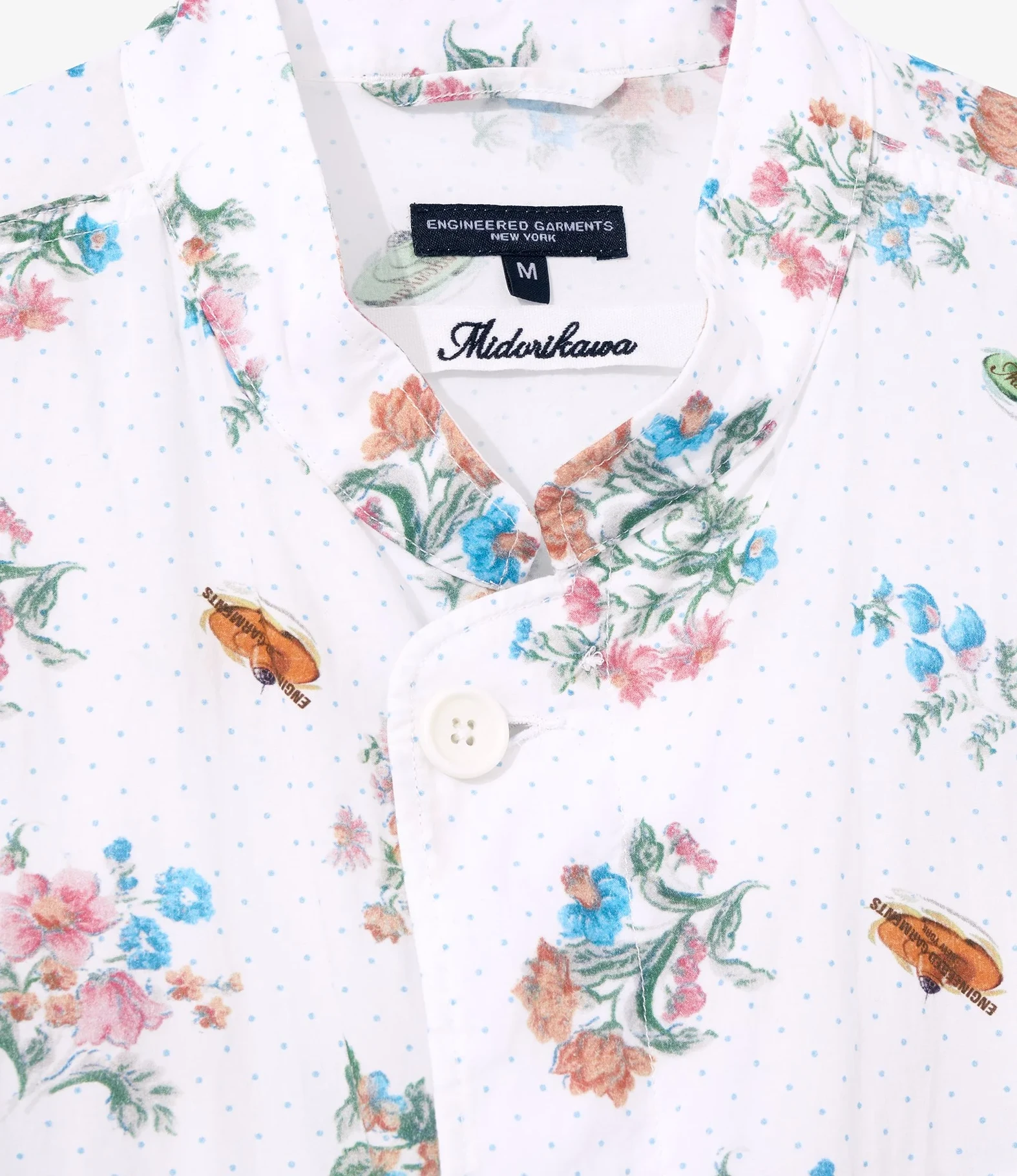
The suit is reversible, cut from uniform serge, the kind of fabric that shows up on municipal workers and army surplus racks rather than runways. The shirt underneath it is floral, printed with a pattern that reads as decorative rather than tactical, a quiet contradiction against the serge's institutional stiffness. Both pieces are presented on the Engineered Garments site this week under a header that states the intention plainly: a new expression of 'Made in America.'
That phrase is doing more work than a typical collaboration blurb. Engineered Garments, designed by Daiki Suzuki and based in New York, has built its entire catalog on a specific kind of looking: American workwear, military surplus, and ivy-league tailoring, filtered through a Japanese eye for proportion and fabric that most domestic heritage labels never developed. It is the same lineage that produced Kamakura Classics and a dozen other Japanese reinterpretations of American dress codes that American labels then rediscover a decade later. Engineered Garments has spent years exporting that reading back into the American market as its own vocabulary.
Midorikawa, the Tokyo label run by Taku Midorikawa, works from inside that same tradition but without the New York address. Pairing the two labels does not import a foreign perspective onto American menswear, it formalizes a loop that was already closed: a Japanese-trained eye defining American tailoring, now working directly with a second Japanese label to say so out loud. The release language, crediting 'a mutual exchange of materials and ideas' between Kenta Miyamoto of Engineered Garments and Midorikawa, treats the partnership as a dialogue between equals rather than a hometown brand importing outside flavor.
This matters because the category Engineered Garments occupies, heritage American workwear, usually markets itself on domestic authenticity: union labels, mill towns, a story about provenance that excludes the possibility that the clearest vision of American dress might have been assembled from abroad. Engineered Garments has never hidden its origins. But naming a Tokyo collaboration explicitly as a new expression of Made in America, rather than as an homage or a crossover, drops the pretense that the two traditions are separate inputs. They are presented here as the same project, carried out from two addresses.
The capsule is small, two garments, no footwear, no accessories bundle. That restraint is itself a signal: this is not a hype drop designed to flood resale channels, it is a working note between two designers who already share a frame of reference. The floral shirt and reversible suit now belong to a specific category of menswear, the kind that treats national dress codes as research material rather than heritage to be protected, open to revision by whoever is looking closely enough.