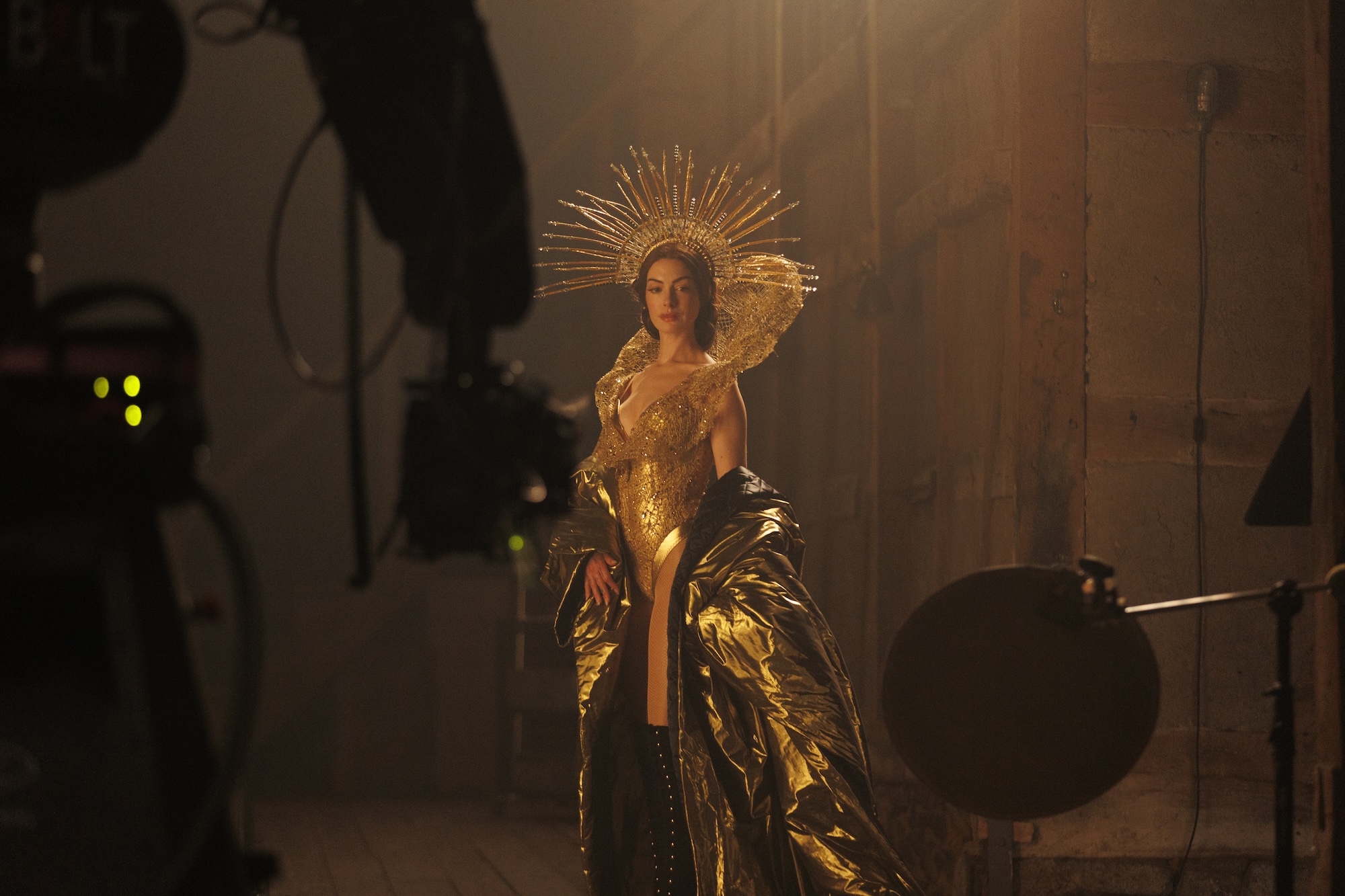
On the seventeenth of April, A24 opened Mother Mary in five theatres in the United States. On the same day, A24 Music released the soundtrack, Mother Mary: Greatest Hits, as a two-disc vinyl record pressed on crimson and gold. On Friday the twenty-fourth, the film expands to a wide release. The album is already in the shop, with a tour-poster tucked into the sleeve. One company, one day, two categories of product, one coherent argument. Ask almost anyone what A24 is and the answer comes back as a film studio.
The Mother Mary release is the clearest demonstration of the gap to date. The seven original songs Anne Hathaway performs in the film were written by Jack Antonoff, Charli XCX, and FKA Twigs. The score is by Daniel Hart, a David Lowery collaborator from A Ghost Story onward. The record ships on A24 Music, the label the company quietly launched in 2022 for the Everything Everywhere All at Once score and has kept in operation, release by release, ever since. A reader coming to the soundtrack through Spotify sees an A24 logo. A reader coming to the film sees the same logo. Asked to name the best independent music labels of the last five years, almost nobody lists A24 at all.

This is a Representation Gap in its structural form. A gap is not ignorance. A gap is mis-classification. The audience is not unaware of what A24 ships. The audience knows about the shop, the tote bags, the film-specific candles, the podcast, the books. But the category the company lives inside, culturally, is still the narrow one it broke out of a decade ago. That is a problem the company cannot fix by shipping more products. Every product reinforces the same misclassification, because the products are all filed under the original header.
The Mother Mary release is the first time the company has shipped two formats, theatrical and recorded music, on the same calendar day, with the same creative director and the same marketing apparatus. The record reviews the film. The film reviews the record. On the A24 app, a reader can tap from a film page to a product page to a soundtrack, and every transition is within the same company. None of the transitions are within the same cultural description.
Why this gap does not close on its own
Category descriptions are sticky the same way captions are sticky. A company's first successful category is the category it stays in, culturally, for a decade after the company has moved. Nike moved into running apps, football cleats, basketball shoes, and the brand stayed in sneakers. Patagonia moved into food, and the brand stayed in fleece. A24 moved into music and merchandise and a subscription app and the brand stayed in indie film. The mechanism is not stupidity, it is compression. Audiences do not keep room in memory for three categories at the same company.
A24's available move is specific. Ship the next release as the record-and-film bundle, not as the film with a tie-in. Run the A24 Music label page as a standalone endpoint, not as a sub-folder of the film site. Put the vinyl in the window of the A24 Shop at Prince Street, which opens later this year, with the same weight as a poster. None of this is new work. It is re-labelling work. The company has the categories. The audience does not have them yet.

The alternative is more patience. A24 has built the most coherent cultural company in American media over the last ten years, and it has done so almost entirely by refusing to explain itself. The description has always been a step behind the work. That has been an advantage up to now, because the work has had room to evolve without the description pinning it. At some point the advantage becomes a cost, because the revenue categories the company is selling into are no longer the category audiences hear when the name comes up. Mother Mary is the weekend the cost becomes specific.